






For a home office, choose a lamp that illuminates your work surface without glaring in your eyes, in neutral white for working during the day. Aim for 400 to 800 lumens placed about 40 cm from your work area, position the lamp on the opposite side of your writing hand, and keep an overhead light on in the room.
This guide explains lumens and lux simply, which light shade to choose, where to place the lamp, and what size to aim for depending on your desk. If you already know what your desk will be used for, go directly to the selection table by use.
Which desk lamp to choose for working from home?
A desk lamp has a simple role. It adds light to the area where you read, write, or type, without shining light into your eyes. To choose it properly, look at four things in this order.
- The amount of light. It is measured in lumens on the product sheet or on the bulb. This determines whether you can see your paper clearly.
- The shade of the light. Warm, neutral, or cool white. It affects your comfort and concentration.
- The lamp's position. On the right side, at the right distance, without reflections on the screen.
- Its size. It should be proportional to the width and depth of your work surface.
Style comes next. A designer desk lamp can work very well, provided you follow these four points. A highly decorative but weak lamp will be more of an accent lamp, useful as a supplement.
If your desk is in a bedroom or living room, the lamp is also visible from the rest of the room. Choose a material and color that match the other lighting fixtures, so the desk area doesn't look out of place.
How many lumens for a desk lamp?
Two words come up constantly when talking about light. They do not mean the same thing, and you only need to understand them once.
Lumens and lux, the difference in two sentences
The lumen measures the light produced by the lamp. The lux measures the light that actually reaches your desk, per square meter. The same lamp will therefore produce a lot of lux if it is close to the work surface, and very little if it is far away.
For reading, writing, or working on a screen, the usual guidelines for a workstation are 300 to 500 lux on the work surface. 500 lux is suitable for reading documents and writing. For detailed work, such as drawing or sewing, you go higher.
The simple guideline for a desk lamp
To illuminate a work area of about 60 × 80 cm, a lamp of 400 to 800 lumens placed 30 to 50 cm from the work surface is sufficient in most cases. Take the top of the range if you are over 50, have dark walls, or a desk far from windows. With age, the eye needs more light for the same level of comfort.
Many decorative lamps do not display their lumens. In this case, look at the type of light source on the product sheet.
- A low-power integrated LED generally provides accent lighting. It is perfect for ambiance, but a bit weak for reading documents for hours.
- An E27 socket, the classic large screw socket, accepts most LED bulbs on the market. You can then choose the lumens and shade of the bulb, within the power limit indicated on the lamp.
To understand the advantages of each solution, read our comparison Integrated LED or replaceable bulb.
Desk lamp, warm, neutral, or cool light?
The shade of the light is measured in Kelvin, denoted by K. The lower the number, the yellower and softer the light. The higher it is, the whiter, or even bluer, it becomes. Many of our product sheets offer three options. Here is how to choose them.
Warm white, around 2700 to 3000 K
This is the light of a classic bulb. It rests the eyes in the evening and makes the room welcoming. Choose it if your desk is in a bedroom or living room, or if you mostly work at the end of the day. For more, read our guide 2700 K or 3000 K.
Neutral white, around 4000 K
This is the best choice for working during the day. Colors remain natural, text is clear, and the light blends well with that from a window. This is also the shade we recommend for homework.
Cool white, above 5000 K
It gives an impression of great clarity. It is useful for precision work during the day, for a short period. In the evening, it can interfere with falling asleep and creates a corporate office atmosphere. Avoid it if your desk is in the bedroom.
The exact Kelvin values of each option are not always indicated. Rely on the name of the option, and in case of doubt, choose neutral white for a work lamp.

Where to place the desk lamp?
A good lamp poorly placed tires you out as much as a bad lamp. Three rules are enough.
On the opposite side of the writing hand
If you are right-handed, place the lamp on the left. If you are left-handed, place it on the right. This way, the shadow of your hand does not fall on the paper. For a child doing homework, this is the most important rule.
On the side of the screen, never in front
Place the lamp next to the screen, slightly forward, and direct the light toward the keyboard or documents. A lamp placed in front of the screen creates reflections. A lamp behind the screen shines light into your eyes. If the screen shines, move the lamp back or turn it a few centimeters until the reflection disappears.
The source hidden at eye level
When sitting, you should not see the bulb. The bottom of the lampshade or cap must remain below eye level. If you see the source, the lamp will glare in your eyes, even if it is low power.
Finally, keep the lamp within reach. You will turn it on more often if the switch is accessible from your chair.

What height and size of lamp for your desk?
A desk generally measures 72 to 75 cm high. When sitting, your eyes are about 45 cm above the surface. This is the figure that determines the height of the lamp.
- Desk 80 to 100 cm wide. A compact lamp 20 to 30 cm high leaves room for the computer and notebooks.
- Desk 120 to 160 cm wide. A lamp 30 to 45 cm high illuminates a larger area and remains in proportion with the piece of furniture.
- Shallow desk, less than 60 cm. Prefer a narrow base. A wide lamp would take up the space of the keyboard.
A lamp taller than 45 cm is still possible if its shade hides the source well. Check on the product photo that the bulb is not visible from the side.
Also consider the footprint of the lamp. On a 100 cm desk, a 15 to 20 cm diameter base remains discreet. A 28 cm diameter shade requires a desk of at least 120 cm.
Notre sélection
Our lamps for a desk of 120 cm and more
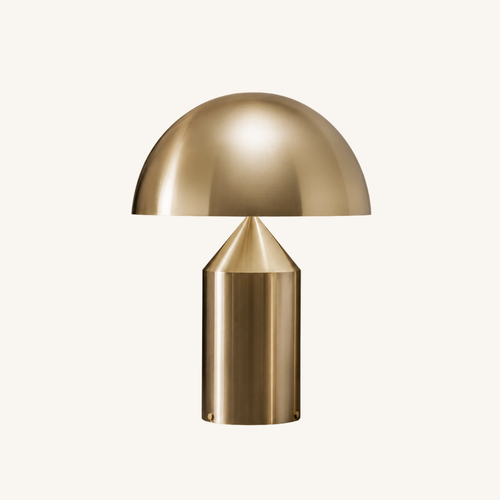
For a small desk or homework corner
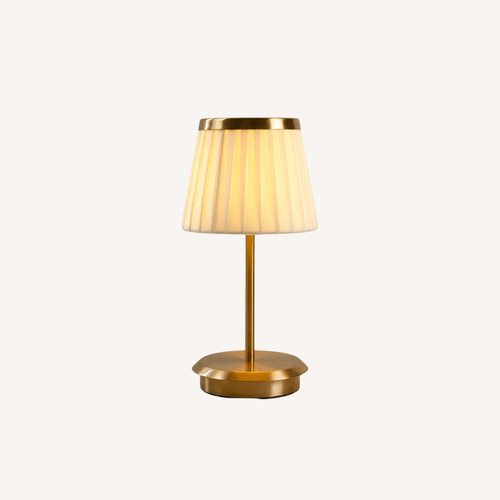
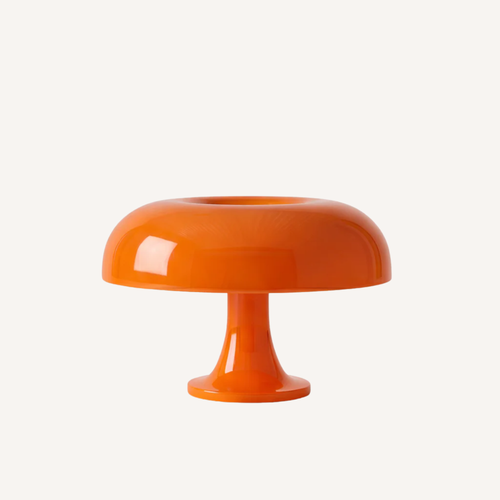
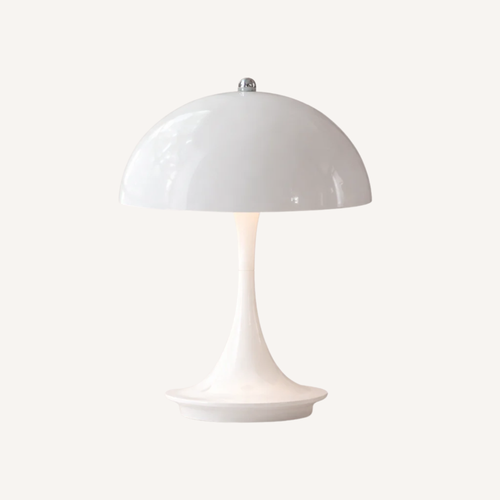
In a child's bedroom or an 80 cm desk area, a small stable lamp is sufficient. It should be light to move and offer neutral white. The Soléa lamp measures 19.5 cm high, is USB powered, and offers 3 shades. The Lunéa lamp measures 23 cm and comes in warm, neutral, or cool white.
Notre sélection
Our compact lamps for a small desk
Is an overhead light needed in addition to the desk lamp?
Working with a single lamp in a dark room tires the eyes. Your gaze constantly moves from a very bright area, the screen and the desk, to a black area, the rest of the room. The eyes are constantly adapting.
Therefore, keep an overhead light on, from the ceiling or with a floor lamp. The desk lamp comes in addition, on the work area. If you want to illuminate the desk from the ceiling, our guide which pendant light for a desk gives the heights and positions that avoid reflections.
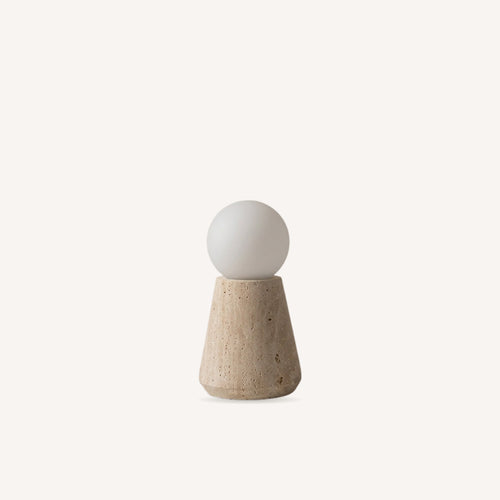
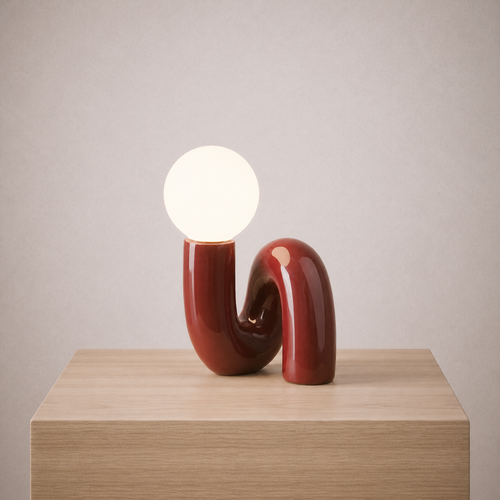
A third lamp, softer, is useful at the end of the day. Placed in the corner of the desk or on a shelf, it replaces the work lamp when you put away your files. It makes the desk area pleasant even when you are not working.

Notre sélection
Our lamps for soft light on the desk
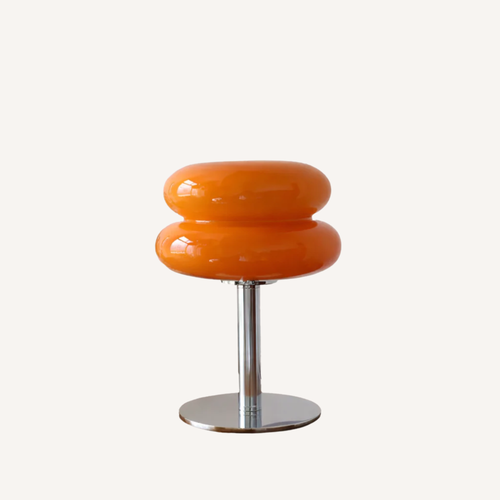
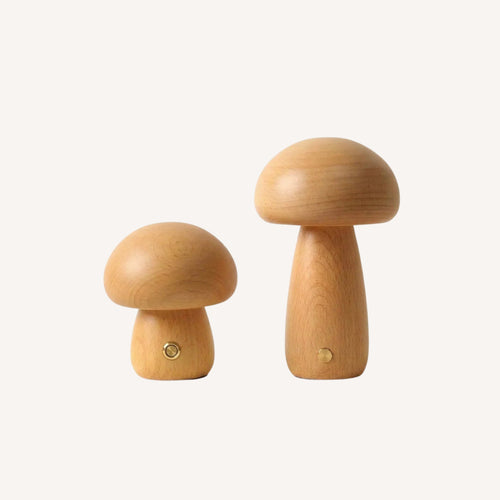
For a desk in a living room corner, a floor lamp can also play the role of general light. It illuminates the room without taking up space on the work surface.
Which desk lamp according to your use?
Locate your situation in this table. It gives you the type of lamp and the shade to choose on the product sheets.
| Your use | What you need | Recommended shade |
|---|---|---|
|
Remote work on screen several hours a day |
A lamp 30 to 45 cm on the side of the screen, plus an overhead light | Neutral white |
|
Homework child or teenager |
A compact and stable lamp, on the opposite side of the writing hand | Neutral white |
|
Reading and writing on paper |
A lamp that sends the light downwards, 30 to 40 cm from the paper | Neutral or warm white |
|
Precision work drawing, sewing, model making |
A powerful lamp, close to the surface, with an E27 bulb of 800 lumens or more | Neutral or cool white |
|
Desk area in a bedroom or a living room |
A decorative lamp that also serves as accent lighting in the evening | Warm white |
|
Desk without a window or very dark |
A work lamp, an overhead light and an accent lamp | Neutral white during the day, warm in the evening |
A 140 cm remote work desk in a bedroom
You work on a laptop all day. The desk is against a wall, a window is on your left, and you are right-handed. In the evening, the desk is part of the bedroom.
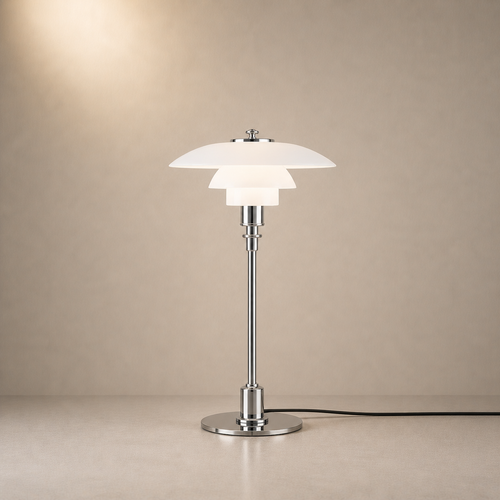
Our choice: the Claréa lamp in neutral white, to the left of the screen. Its 45.5 cm height and 28.5 cm diameter illuminate a wide area, and its stacked diffusers hide the bulb. In the evening, a small lamp in warm white takes over.
A 90 cm homework corner in a child's bedroom
The child is right-handed and does homework after school, often when it is already dark in winter. The lamp should be light and easy to adjust.
Our choice: the Lunéa lamp in neutral white, placed to the left of the notebook. It measures 23 cm high and leaves room on a small work surface. Keep the ceiling light on at the same time.
A secretary desk in a living room
You use it for papers and a few hours of work per week. The rest of the time, it is part of the decor.
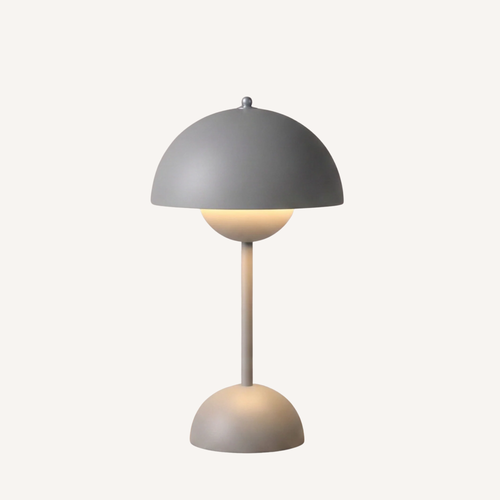
Our choice: the Bruméa lamp, 31 cm high, in a color that matches the living room. Its dome diffuses a soft light. For long sessions, add an overhead light.

Mistakes to avoid
- Placing the lamp on the side of the writing hand. The shadow of the hand falls on the paper. A right-handed person places their lamp on the left.
- Placing the lamp in front of the screen. It creates reflections that force the eyes. Put it on the side.
- Seeing the bulb from your chair. The source must remain below eye level or hidden by the shade.
- Working in the dark with a single lamp. The contrast tires the eyes. Keep an overhead light on.
- Choosing cool white for a desk in the bedroom. In the evening, it makes the room harsh and can interfere with sleep.
- Taking a lamp too large for a small desk. It takes up the space of the notebooks and you end up moving it.

Your questions
Which desk lamp to choose for remote work?
Choose a lamp 30 to 45 cm high, in neutral white, that hides its source. Place it on the side of the screen, on the opposite side of the writing hand. Keep an overhead light on in the room to limit eye fatigue.
How many lumens for a desk lamp?
Allow 400 to 800 lumens for a lamp placed 30 to 50 cm from the work surface. This gives about 300 to 500 lux on the useful area, the usual benchmark for reading and writing. For precision work or if you are over 50 years old, take the top of the range.
Desk lamp, warm or cold light?
For working during the day, neutral white, around 4000 K, is the best compromise. Warm white is suitable for the evening and for offices located in a bedroom or living room. Cold white is reserved for precision work during the day.
Which side to put the desk lamp on?
On the opposite side of the writing hand. A right-handed person places it on the left, a left-handed person on the right. The shadow of the hand then does not fall on the sheet.
How to avoid lamp reflections on the screen?
Place the lamp next to the screen, never in front. Direct the light towards the keyboard and documents. If a reflection appears, move it back or turn the lamp a few centimeters.
Can a decorative lamp serve as a desk lamp?
Yes, if it gives enough light and hides its source. A small built-in LED serves rather as a supplement. A lamp with an E27 socket allows you to choose a more powerful bulb, within the limit indicated on the lamp.
Find the lamp for your desk
Measure the width of your desk and identify your use in the table. Then compare the heights, shades, and materials on the product sheets.
Free delivery · 30-day returns · Secure payment
