






For a living room, the best choice is a set of lights. Take a pendant or ceiling light for general lighting, a floor lamp for reading, then one or two lamps or wall lights for the evening. Allow 3 to 5 light sources and 100 to 200 lumens per m² in total, in warm white 2700 K.
This guide helps you choose each light, the right size and in the right place. If you already know the area of your living room, go directly to the size chart.
What light for a living room?
The first mistake is to leave everything to the ceiling light. A single source in the center flattens the volumes, hardens faces and leaves the corners in shadow. Designers therefore light a living room in 3 layers of light, and each layer has a specific role.
Ambient lighting, to see the whole room
This is the general light, the one that allows you to move around and see the whole room. It almost always comes from the ceiling, with a pendant, a chandelier or a ceiling light. It must be even and not glare. Ideally, a dimmer allows you to lower its intensity in the evening.

Functional lighting, for reading and relaxing
A reading chair, the sofa corner or a side desk requires stronger and more targeted light, around 300 lux. Lux measures the amount of light that falls on a surface. The reading floor lamp or arc lamp is best, as it lights over the shoulder without fixing anything to the ceiling.

Accent lighting, for the evening atmosphere
This layer gives the living room its relief. It includes wall lights, table lamps on a console or shelf, and spotlights directed at a painting. These small sources create soft shadows and a warm atmosphere in the evening.
In the evening, turn off the ceiling light and keep only the floor lamp, the lamps and the wall lights. The light then comes from several low sources, and not from a single source above your head.

What light for what use?
Each family of lights has its role in the living room. This table helps you compose your set without duplication or shortage.
| Light | Ideal for | Avoid if |
|---|---|---|
|
Pendant Atmosphere |
Create a focal point above the coffee table or dining area | The ceiling is less than 2.40 m in a passageway |
|
Ceiling light Atmosphere |
Light evenly, under a low ceiling or in a very used room | It is your only light source |
|
Chandelier Atmosphere and decoration |
A large living room, with 2.70 m ceiling height or more, in an elegant style | The room is small, as it crushes the space |
|
Floor lamp Functional |
Read on the sofa, equip a chair corner, light without work | The passage is very narrow |
|
Wall light Accent |
Create halos on the walls, frame a sofa or a fireplace | The wall does not have an electrical connection. Then prefer a model with a cable and plug |
|
Table lamp Accent |
A console, a sideboard, a shelf or an end table, with a low light | No particular contraindication |
|
Adjustable spotlights Accent |
Highlight a painting, a bookcase or a textured wall | They serve as the main lighting |
Pendant or ceiling light: what to put in the center?
The answer depends mainly on your ceiling height and the use of the room. Here is what each solution brings.
The pendant, the decorative choice
- It gives character and structures the space.
- Its light is warmer, because it is often filtered by the material.
- It is very suitable above a coffee table or a dining area.
- It requires at least 2.50 m ceiling height in a passageway.
The ceiling light, the practical choice
- It is suitable for a low ceiling, because it never hinders passage.
- It lights a large area evenly.
- Dimmable LED models go from a strong light to a soft light.
- It is less decorative and must be complemented by accent sources.

Our rule according to the height
Under 2.40 m, choose a thin ceiling light. Read our guide what light for a low ceiling. Between 2.40 and 2.70 m, a compact or adjustable pendant is very suitable, as explained in our guide what pendant for a 2.50 m ceiling. Beyond 2.70 m, you can take a large pendant or a chandelier.
Notre sélection
Our models for the center of the living room
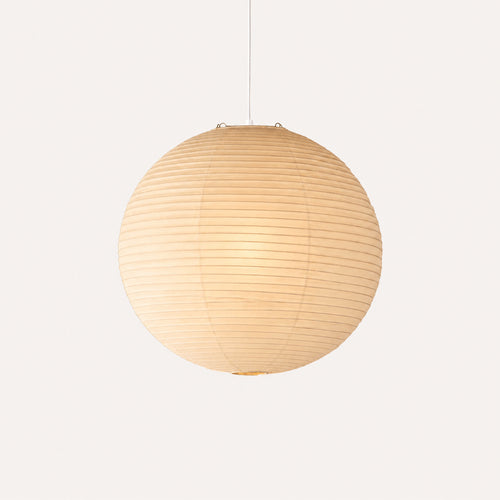
Sérora
Paper · Ø 20 to 70 cm
À partir de 328,00 kr
Voir le produit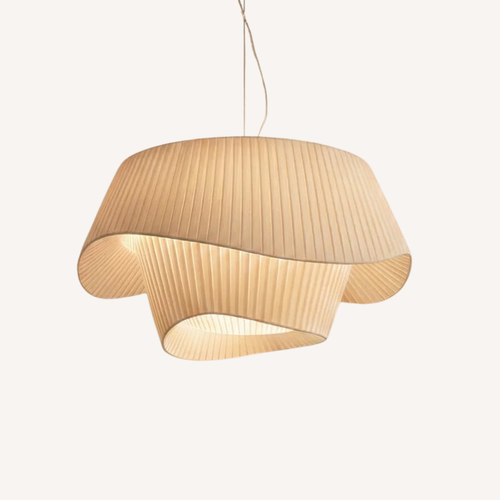
Nuvora
Pleated fabric · Ø 50 or 60 cm
À partir de 2.296,00 kr
Voir le produit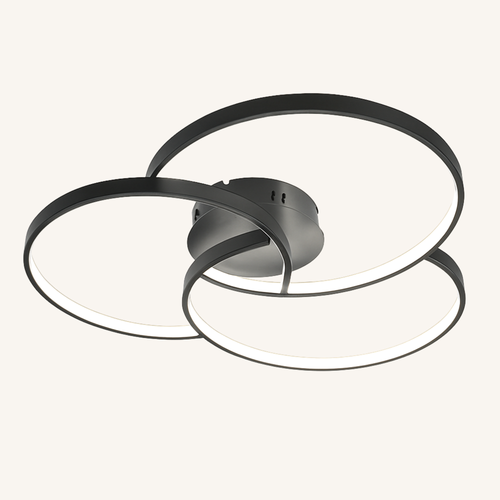
Dimmable Three-Circle LED Flush Mount Ceiling Light
Dimmable LED · Ø 58, 74 or 90 cm
À partir de 3.007,00 kr
Voir le produit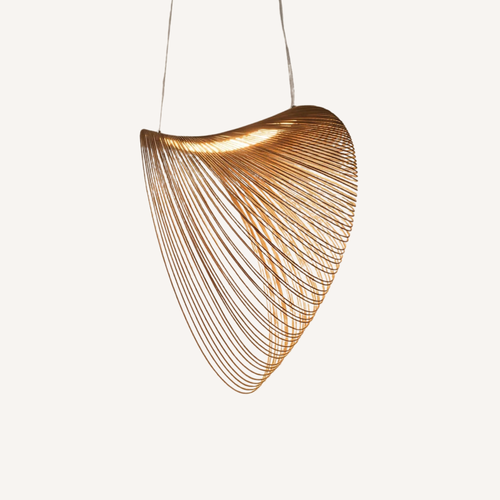
Brisora
Wood and bamboo · Ø 40, 60 or 80 cm
À partir de 2.734,00 kr
Voir le produitWhat size and power for a living room?
A light that is too small is the most common mistake. Three landmarks are enough to aim right.
- The diameter. Add the length and width of the room in meters, then multiply by 8. You get the maximum recommended diameter in centimeters for the central light.
- The amount of light. The lumen measures the light emitted by a source. In a living room, the average landmark is 150 lumens per m², with a range of 100 to 200, to be distributed over all sources.
- The passage. Ideally keep 2.10 m free under a pendant where people walk, and 2.00 m at minimum.
Let's take a living room of 5 × 4 m. The calculation gives (5 + 4) × 8 = 72 cm. A decorative pendant can approach this size, while a flat and diffusing ceiling light of 50 to 60 cm is more than enough. These 20 m² require 2,000 to 4,000 lumens in total, distributed between the ceiling light and the other sources.
| Living room area | Ceiling light diameter | Light and light sources |
|---|---|---|
| Less than 15 m² | 35 to 45 cm | 1,500 to 3,000 lumens, 3 light sources |
| 15 to 20 m² | 45 to 55 cm | 2,000 to 4,000 lumens, 3 to 4 light sources |
| 20 to 30 m² | 55 to 70 cm | 3,000 to 6,000 lumens, 4 to 5 light sources |
| More than 30 m² | 70 cm and more, or 2 ceiling lights | 4,500 lumens and more, 5 light sources and more |
To go further, read our method for choosing the size of your ceiling light, our guide what ceiling light for a 20 m² living room and the step-by-step calculation of how many lumens for a living room.
Where to place the lights?
For balanced light, arrange your accent sources in a triangle in the room, rather than all on the same side. The gaze then moves from one light source to another, and no corner remains in the dark. Follow these four steps.
- Center the ambient light on the living area. It is often the coffee table, and rarely the exact center of the room. A pull-out hook, a hook fixed to the ceiling that moves the cable, allows to offset a pendant.
- Place the floor lamp. Put it at the end of the sofa or behind the reading chair, slightly set back, so that the light comes over the shoulder.
- Balance with two accent sources on the opposite side. Provide a lamp on the console or TV cabinet, then a wall light or a pair of wall lights on the emptiest wall.
- Vary the heights. Provide a low source with a lamp, one at eye level with a wall light at 1.60 or 1.80 m, and a high source on the ceiling. These differences give depth to the room.

Notre sélection
Our floor lamps for reading on the sofa or lighting a corner
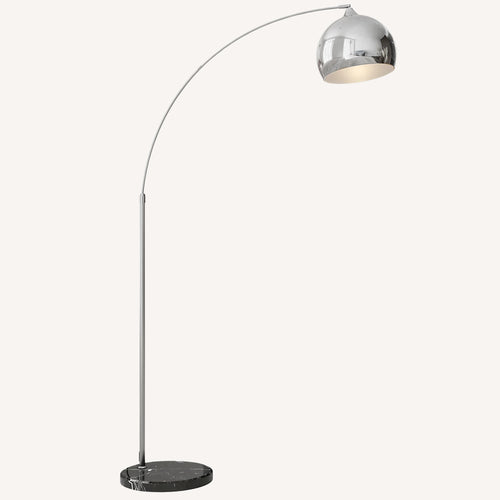
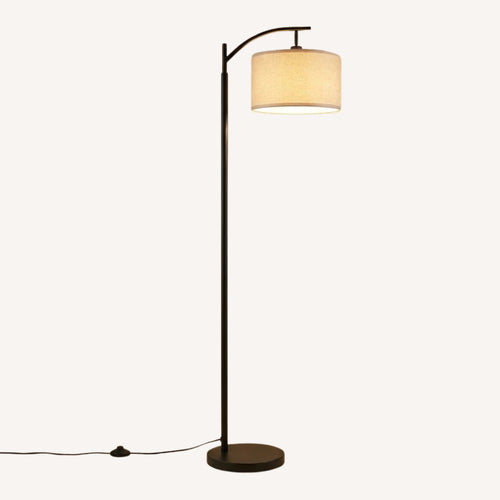
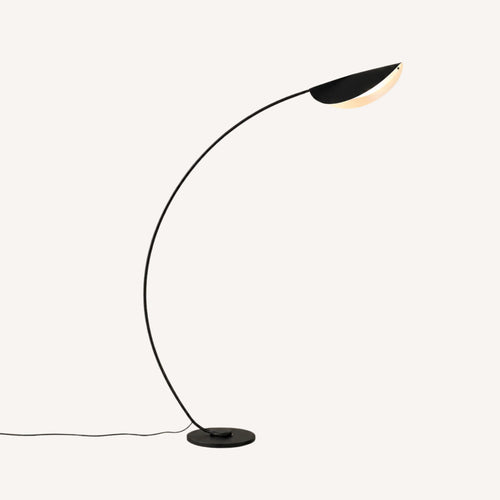
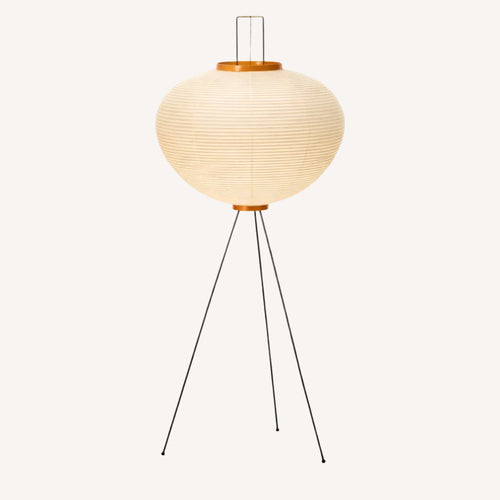
Three typical living rooms
A small living room of 14 m², with a 2.50 m ceiling
The room is compact, with a two-seater sofa and little room to move. The atmosphere is Japandi, a mix of Japanese and Scandinavian styles. You need a soft light, without a massive light fixture.
Our choice: the Sérora pendant in Ø 40 cm, light and diffusing, then the Sérune pleated paper lamp on the console. Add the Siléil wall light near the sofa, because it sends the light up and down. Other ideas are in our guide what pendant for a small living room.
A family living room of 25 m², with a 2.50 m ceiling
The rectangular room serves during the day as well as in the evening, with a reading corner and a TV cabinet. You need a powerful general light, that can be lowered.
Our choice: the Rosélis ceiling light in Ø 58 or 74 cm, with adjustable intensity, then the Chromiro arc floor lamp above the sofa. Add two white Eclipséil wall lights in Ø 20 cm around the TV cabinet and the Linuna lamp at the end of the sofa.
A large living room of 35 m², with a 3 m ceiling
The volume is generous, with large windows and light walls. Without distributed sources, the room looks empty and cold in the evening. The spirit is natural.
Our choice: the Brisora pendant in Ø 80 cm above the sofa corner, then the Noctaro arc floor lamp of 200 cm for reading. Place the Lumaro floor lamp in the opposite corner and direct the Rampélis spotlights towards the bookcase. Their GU10 bulbs are provided in neutral light. To keep a single shade in the room, replace them with warm white GU10 bulbs.

What style of light for your living room?
Once the functions are chosen, the material gives the atmosphere. Keep a coherent family of materials between your lights, with two or three materials at most.
Natural and Japandi
Paper, rattan, light wood and linen give a filtered and soft light, which draws shadows on the walls. Look at our paper collection and our rattan collection.
Mineral and warm
Travertine, a natural stone, and dark wood warm up a minimalist interior, with simple volumes. Discover our travertine collection, with pendants, wall lights and lamps.
Retro
Lacquered metal, opaline glass and colors suit a more cheerful living room. Mushroom shapes, stacked discs and orange or olive green shades mark this style well. See our Scandinavian and retro collection.
Elegant and luminous
Crystal, brass and glass suit a Haussmannian living room or a reception room. See our crystal chandelier collection.
Notre sélection
Nos lampes et appliques pour la lumière du soir

Linuna
Bois · abat-jour plissé ivoire
1.083,00 kr
Voir le produit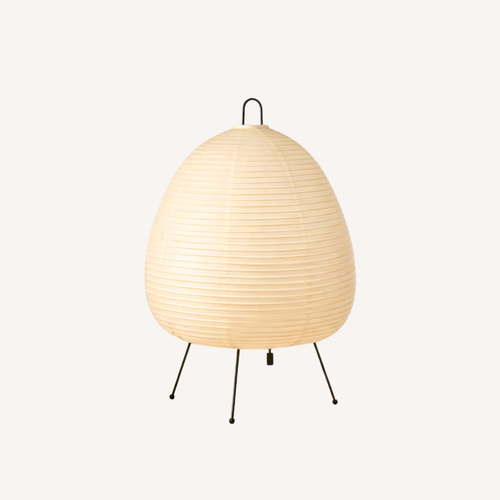
Sérune Japandi Style Pleated Paper Table Lamp
Papier plissé · 47 cm de haut
646,00 kr
Voir le produit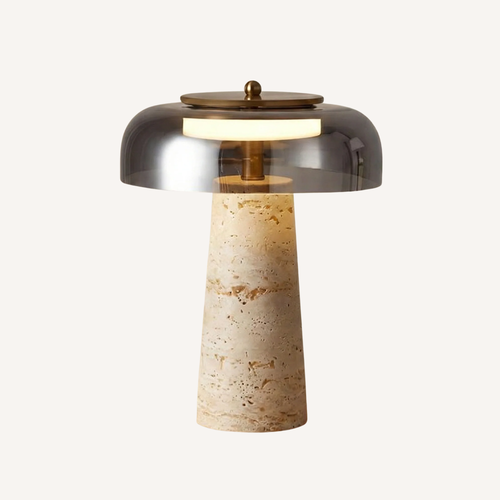
Travénoir
Travertin · verre transparent ou teinté
2.952,00 kr
Voir le produit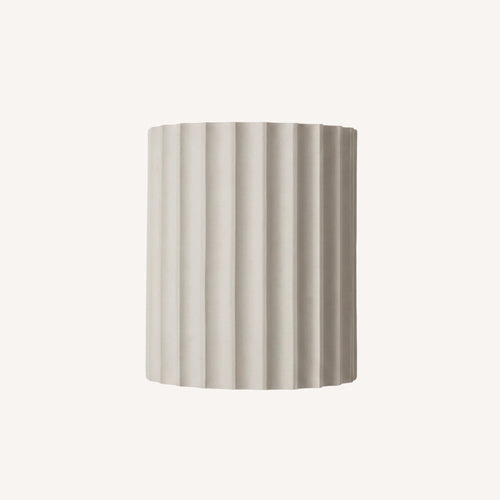
Siléil
Résine · lumière en haut et en bas
711,00 kr
Voir le produitQuelle lumière choisir : 2700 K, IRC et variateur ?
Un beau luminaire équipé d'une mauvaise ampoule donne une mauvaise lumière. Quatre points comptent dans un salon.
- La température de couleur. Elle se mesure en Kelvin (K), et plus le chiffre est bas, plus le blanc est chaud. 2700 K est la référence pour un salon chaleureux. 3000 K convient aux salons très lumineux ou à dominante blanche. Évitez 4000 K et au-delà. Lisez notre comparatif 2700K ou 3000K pour un salon.
- L'IRC. L'indice de rendu des couleurs indique si les couleurs restent fidèles sous la lumière. Visez 90 ou plus pour que les tissus, le bois et les teints gardent leurs vraies couleurs.
- Le variateur. Cet appareil permet de passer d'une lumière de ménage à une lumière de soirée. Vérifiez que l'ampoule ou la LED est bien compatible, ce qui s'indique par le mot dimmable.
- Une seule température par pièce. Mélanger 2700 K et 4000 K donne un résultat peu harmonieux.
Si vous hésitez entre une LED intégrée et une ampoule classique, lisez notre guide LED intégrée ou ampoule remplaçable.
Les erreurs à éviter dans un salon
- Tout miser sur le plafonnier. Une source unique au centre aplatit la pièce. Ajoutez au moins deux sources d'appoint.
- Choisir un luminaire trop petit. Un plafonnier de 30 cm dans un salon de 25 m² paraît perdu. Utilisez la formule donnée plus haut.
- Suspendre trop bas dans le passage. Gardez au moins 2 m sous le luminaire là où l'on circule, et idéalement 2,10 m.
- Mélanger les températures de couleur. Restez sur une seule teinte de blanc chaud dans toute la pièce.
- Oublier le coin lecture. Sans source réservée à cet endroit, on finit par allumer le plafonnier à pleine puissance.
- Laisser des ampoules nues qui éblouissent. Préférez des diffuseurs en papier, en verre opalin ou en tissu, ou des ampoules à filament douces.
Nous détaillons ces pièges dans notre article comment bien éclairer un salon, les erreurs à éviter.
Avant d'acheter, vérifiez ces 6 points
- Vous avez mesuré la longueur, la largeur et la hauteur sous plafond.
- Vous avez repéré vos zones de vie, comme le canapé, le coin lecture, le coin repas et le meuble TV.
- Vous avez prévu au moins une source pour chaque couche, soit l'ambiance, la lecture et l'accent.
- Vous avez vérifié l'emplacement du point lumineux au plafond et des prises murales.
- Vos ampoules sont en 2700 K, avec un IRC de 90 ou plus, et compatibles avec votre variateur si vous en installez un.
- Vos luminaires partagent une même famille de matières ou de finitions.
Vos questions
Quel est le meilleur luminaire pour un salon ?
Le meilleur choix est une bonne combinaison. Prenez une suspension ou un plafonnier pour l'ambiance générale, un lampadaire pour la lecture, puis une ou deux sources d'accent, comme une applique ou une lampe à poser. Cet ensemble rend le salon pratique et chaleureux.
Combien de luminaires faut-il dans un salon ?
Comptez 3 points lumineux pour un petit salon de moins de 15 m², 4 pour un salon de 20 à 25 m² et 5 ou plus au-delà de 30 m². Répartissez-les à différentes hauteurs, au sol, à mi-hauteur et au plafond.
Suspension ou plafonnier dans un salon ?
Sous 2,40 m de hauteur sous plafond, choisissez un plafonnier fin. Entre 2,40 et 2,70 m, une suspension compacte ou à câble réglable convient, surtout au-dessus d'une table basse ou d'un coin repas. Au-delà de 2,70 m, une grande suspension ou un lustre met le volume en valeur.
Quelle taille de luminaire pour un salon de 20 m² ?
Pour un salon de 5 × 4 m, la formule donne un diamètre maximum de 72 cm. En pratique, un plafonnier de 50 à 60 cm ou une suspension de 50 à 70 cm conviennent. Complétez avec d'autres sources pour atteindre 2 000 à 4 000 lumens au total.
Quelle lumière choisir pour un salon cosy ?
Choisissez un blanc très chaud de 2700 K, des diffuseurs en matières naturelles comme le papier, le tissu, le rotin ou le travertin, et un variateur. Le soir, préférez les lampes, le lampadaire et les appliques, puis éteignez le plafonnier.
Où placer un lampadaire dans un salon ?
Placez-le à l'extrémité du canapé ou derrière un fauteuil, légèrement en retrait, pour que la lumière arrive par-dessus l'épaule. Un lampadaire arc peut aussi éclairer une table basse sans toucher au plafond.
Composez l'éclairage de votre salon
Vous savez combien de sources il vous faut ? Comparez les suspensions, les plafonniers, les lampadaires et les appliques sur les fiches produits.
Livraison offerte · Retours 30 jours · Paiement sécurisé
