






Choose a solid wood coffee table if you want a piece of furniture you can sand and repair, with clearly visible grain. Choose MDF, a pressed wood fiber panel, for complex shapes such as curves, grooved fronts, or a lift-top surface. Keep it in a dry room, as water causes it to swell irreversibly. Weight does not prove quality, as pine weighs around 550 kg per cubic meter and MDF weighs 600 to 800 kg.
This guide compares solid wood, MDF, and particleboard by weight, strength, and lifespan. To decide quickly, look at the materials table. It shows when to choose each material and what to look out for.
Solid wood or MDF coffee table: which should you choose?
No material is the best overall. The right choice depends on how you use it. Here is what distinguishes each family, followed by what the product pages in our coffee table collection state.
| Material | When to choose it | What to look out for |
|---|---|---|
| Solid pine | You want real grain, a slightly different piece with each table, and the ability to sand it one day | Soft to medium-hard wood; impacts leave marks |
| MDF | You like curved shapes, grooves, or a lift-top surface | Standing water and damaged edges |
| Particleboard | You are looking for a large top with a decorative finish, for everyday use in dry conditions | Moisture, especially on the edges |
| Engineered wood | You want a light wood look and simple lines | The term is broad and does not specify which panel is used |
| Material not specified | The product page describes a finish without stating the composition, so do not assume it is solid wood | Ask for confirmation before purchasing if this point matters to you |
Here is what our product pages say, model by model. When a product page does not name a material, we indicate it. We prefer to refer you to customer service rather than guess.
- Solid pine. The solid pine table, 110 × 50 cm and 33.5 cm high.
- MDF. The narrow table measuring 80 × 30 cm and the oval lift-top table measuring 110 × 55.5 cm. The set of 2 round tables has water-resistant MDF tops, and the 3-tier side table has 1.5 cm tops.
- Particleboard. The walnut-effect round table, Ø 85 cm, with a 2.5 cm top.
- Engineered wood. The oak-effect table measuring 90 × 60 cm and the square oak-effect table measuring 100 × 100 cm.
- Material not specified. The round brown wood table, the set of 2 round wood tables, the walnut lift-top table and the double-storage lift-top table. The same applies to the Sonoma table, the Artisan Oak table and the rectangular wood-effect table.
Notre sélection
Our solid pine and MDF tables
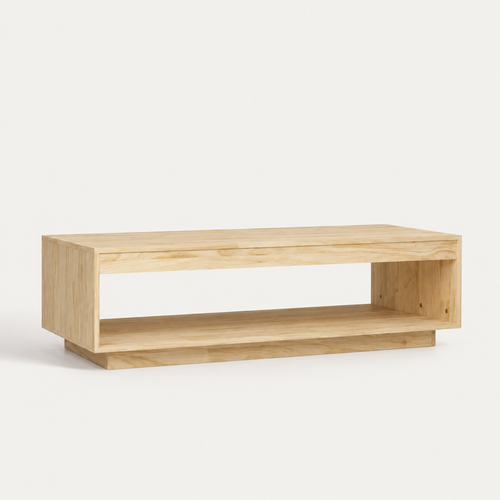
Almacenaje abierto y diseño natural
Pin massif · 110 × 50 cm
£204.00
Voir le produit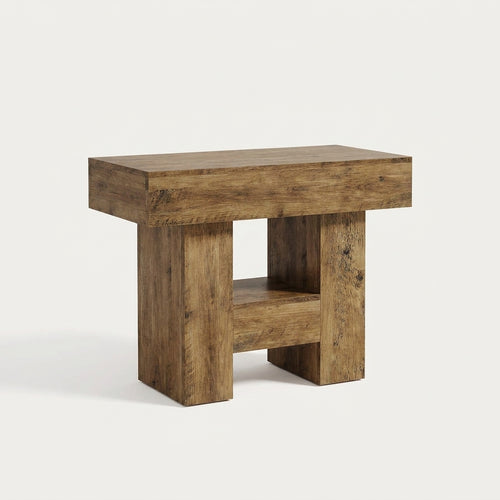
Farmhouse Style with Open Storage
MDF · 80 × 30 cm
£256.00
Voir le produit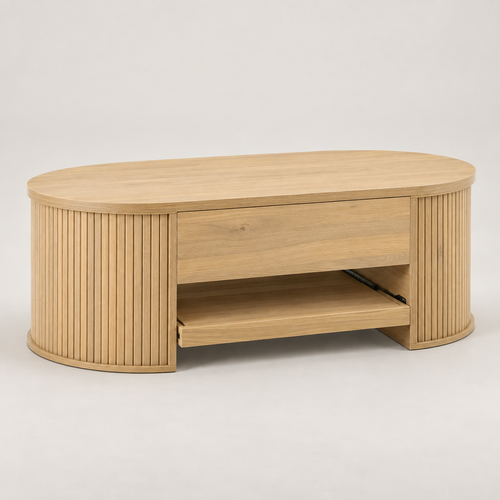
Almacenaje Integrado y Líneas Curvas
MDF · plateau de 110 × 55,5 cm
£282.00
Voir le produit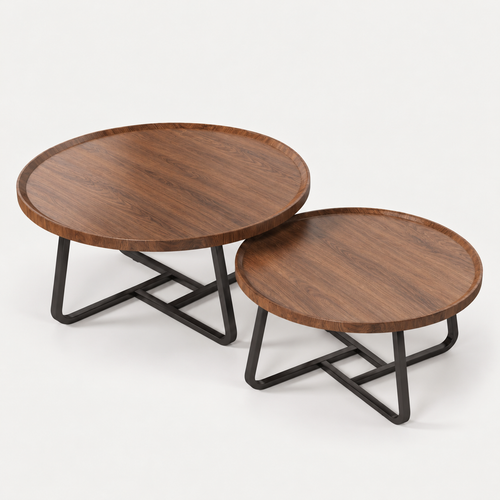
Mid-Century Style and Space-Saving
Plateaux en MDF · 80 et 60 cm
£278.00
Voir le produitThis guide compares materials. For dimensions or the shape to match your sofa, read our guide which coffee table with my sofa.
Solid wood, MDF, particleboard, veneer: what do these words mean?
The same table can be called "wood" in a title and be made of panel in the details. Before comparing, here is the meaning of each word.
Solid wood
The top is cut from wood, sometimes from several assembled planks. It is a single material throughout its thickness, and the grain on top continues through the top. It reacts to humidity in the air and may move slightly with the seasons.

This is the only table in this guide presented as solid on its product page.
MDF
MDF is made of pressed wood fibers. According to Natural Resources Canada, it consists of approximately 82% wood fibers, 9% binder, 8% water, and 1% wax. Its surface is smooth, and its edges can be shaped like wood, hence the grooves and curves.
Particleboard
These are small wood chips pressed hot with resin, in several layers. It is also called chipboard. The resin generally does not resist water, and the panel is most often covered.
Veneer
Veneer is a very thin slice of real wood, a few tenths of a millimeter thick, glued to a panel. The result is that of wood, but sanding remains very limited. Our coffee table product pages do not mention veneer.
Melamine and wood effect
Melamine is a resin-impregnated sheet, hot-pressed onto MDF or chipboard. It imitates a decorative finish. The words walnut effect or oak effect describe an appearance. They say nothing about the type of wood.
Engineered wood
This term includes products made from glued wood, such as plywood, particleboard, and MDF. Our two oak-effect tables indicate it on their product pages, without specifying the type of panel. We therefore cannot say more here.
A scratch does not have the same effect depending on the material. On solid wood, sanding returns it to the same wood. On a panel, the finish represents only a fraction of the thickness. A deep scratch reaches the support and cannot be erased with sandpaper.
Is a solid wood table heavier?
Not necessarily. Weight is a poor indicator of quality, as it all depends on the type and density of the panel. Pine is a rather light wood, while MDF is a dense material.
Specific gravity indicates the weight of a cubic meter of material. Scots pine weighs around 550 kg/m³, or 500 to 560 according to sources. Oak weighs around 680 kg/m³, or 670 to 760 according to sources. MDF weighs 600 to 800 kg/m³ and chipboard 600 to 750.
For the same size, an MDF table can therefore be heavier to move than a pine table. A solid and thick top will always weigh more than a thin top, regardless of the material. If you often move your table to unfold a convertible, look first at the size and the legs. You can also choose a duo like the set of 2 round tables, which its product page describes as light and easy to move.
Weight also does not indicate what a table can support. Our product pages state 90 kg for the walnut-effect round table, 45 kg for the narrow table in MDF, and 22 kg for the tops of the industrial side table. The solid pine table does not indicate a load, and the word solid does not replace this figure.
Water, stains, scratches: what daily resistance?
A coffee table receives glasses, cups, and remote controls. This is where the differences are seen most quickly. Here is what happens depending on the situation.
- A spilled glass, quickly wiped up. It remains without consequence on all materials, if the wood is protected and if the surface of the panel is intact.
- Standing water, a trace of vase. On solid wood, a halo may appear, often fixable. On MDF, swelling is irreversible if water reaches the fibers. Particleboard can swell and discolor.
- A light scratch. Solid wood is sanded and repaired. On MDF and particleboard, it all depends on the finish, and repair is difficult.
- The impact of a heavy object. Solid wood dents on soft woods. MDF and particleboard can chip on the edges.
The finish therefore matters as much as the material. The round brown wood table states a finish resistant to scratches and stains. The set of 2 round tables states water-resistant MDF tops, with a rim that holds objects. Resistant does not mean invulnerable, so keep coasters and a cloth handy.
On a panel, watch especially the edges and the drillings, because water seeps in there. Once the protection is breached, the support can swell or peel off. Quickly wipe up a leak of vase or plant, and do not place a pot directly on the top.

Notre sélection
Our panel tables, for use in dry conditions
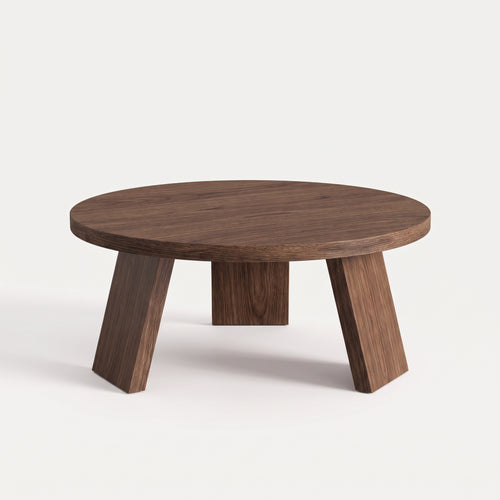
Angled Legs and Vintage Style
Panneau de particules · Ø 85 cm
£204.00
Voir le produit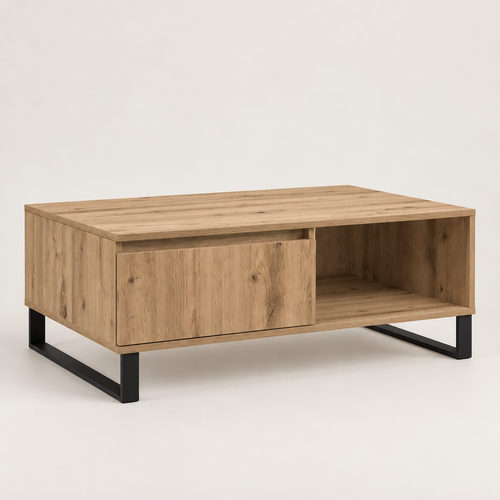
Diseño minimalista y líneas naturales
Bois d'ingénierie · 90 × 60 cm
£213.00
Voir le produit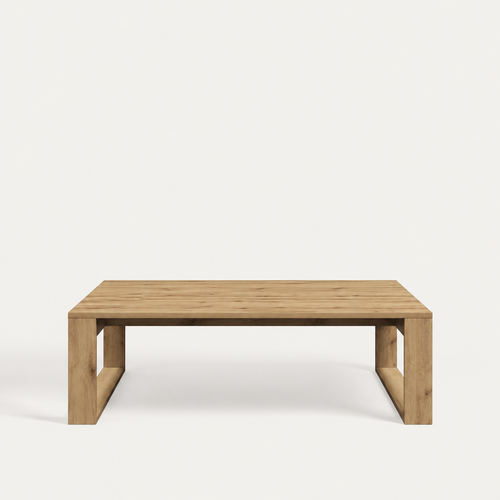
Volumen minimalista y acabado natural
Bois d'ingénierie · 100 × 100 cm
£154.00
Voir le produit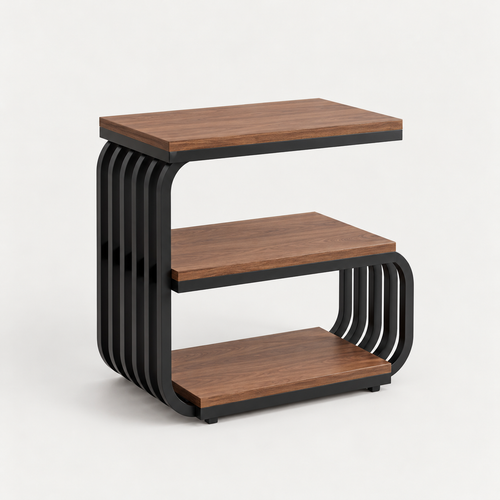
Rustic Wood and Black Metal
Plateaux en MDF · 65 × 35 cm
£234.00
Voir le produitHow long does a coffee table last?
Beware of numbered durations. We have found no standard or reliable measure that gives a number of years according to the material. An MDF top in dry conditions can age very well, and a solid top left in the sun or under a leaking vase can quickly deteriorate. What changes is what happens after the first accident.
- Solid wood can be repaired. A scratched top is sanded, oiled or restained, and the marks can become a patina. On pine, knots and resin can react under a finish.
- MDF is replaced more than it is repaired. Painting a healthy MDF is simple, but a swollen area does not regain its shape. The fixings hold less well there than in solid wood, so avoid repeated disassembly.
- Particleboard depends on its coating. As long as it is intact, the whole remains clean. Once pierced or peeled, moisture settles in, and the repair remains mostly aesthetic.
Three gestures that prolong any table
- During assembly, tighten without forcing. A screw too tight fatigues a panel faster than solid wood.
- Daily, use coasters and a slightly damp cloth, the maintenance recommended by most of our product pages. Avoid a soaked sponge and abrasive products.
- During a move, disassemble only if necessary. Lift the table by its structure, never by its lift-top or its shelf.
One last point concerns the air in the room. The glues of the panels can emit formaldehyde, an irritating compound. Some guides recommend classes E0 or CARB2 when the information exists. Our coffee table product pages do not specify this class, so ask the question before ordering if this criterion matters to you, and ventilate the room after assembly.
Which material according to your living room and your use?
Look first at the appearance, then at your use. Solid wood shows irregularities, the wood effect gives a more regular image, and MDF allows shapes that are harder to obtain in solid wood.
Appearance and warmth
- The grain. Solid pine offers veins that vary from one table to another. The walnut effect and oak effect finishes give a grain without going through solid walnut or oak.
- The shape. The oval top and the grooved fronts of the oval lift-top are well suited to MDF, because it can be hollowed out, rounded, and grooved with a regular surface.
- The mechanism. Several of our lift-top tables combine a mobile top and hidden storage. Our guide coffee table with storage compares them.
- The light. A grazing light accentuates the reliefs and the scratches. A warm and soft light highlights all woods, solid or not. For the lighting around the table, read our guide which light fixture for a living room.

Never judge a table by the photo alone or by the title alone. A surface of very raw appearance can be a panel, and a very smooth top can be wood. Look for the phrase that names the material on the product page. If it does not exist, the material is not confirmed.
According to your situation
- You want to keep your furniture for a long time. Choose solid wood so you can sand it and renew the finish. Look at the solid pine table.
- You dine or work in the living room. Choose a lift-top table, accepting that it will have a panel top. Look at the oval lift-top table, which rises from 40 to 55 cm high.
- You have a small living room and a narrow walkway. First check the dimensions and depth, then the material, with the narrow 80 × 30 cm table.
- You display plants, vases and bouquets. Always protect the tabletop, especially if it is a panel. Look at the set of 2 round tables, with tops that are water-resistant according to the product sheet.
- You have a large corner sofa. Choose a large, simple surface, such as the 100 × 100 cm oak-effect square table.
- You have children or pets. Look at the finish and shape before the material. The round brown wooden table has a scratch- and stain-resistant finish.

Notre sélection
Our practical everyday models
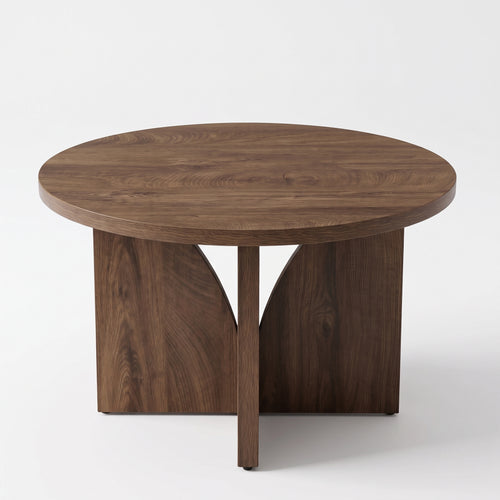

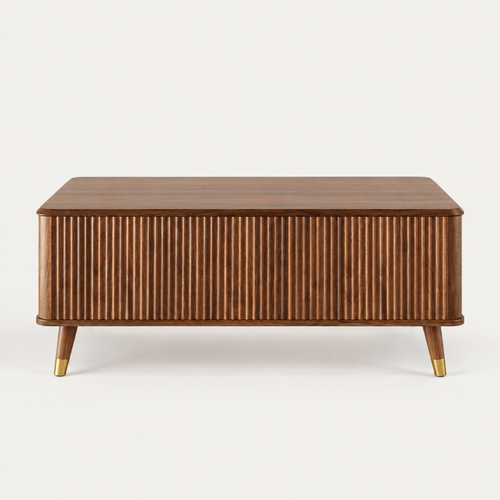
The sofa matters too. A lightweight table will be easier to move aside to open a sofa bed. To choose the seating, read our guide on how to choose a comfortable sofa and see our collection of designer sofas. To match the colour, read walnut or oak coffee table.
Three practical examples
A 20 m² living room, to keep the table for a long time
The sofa is 200 cm long. The couple prefers to repair rather than replace and likes the small irregularities of wood. The plants sit on the windowsill, away from the table.
Our choice: the 110 × 50 cm solid pine table, which is 55% of the sofa's length. Its 107.5 cm wide open space holds baskets and magazines.
A 26 m² studio, between office and living room
The computer is used in the evening, and meals are eaten in front of a film. You need a lift-top and storage for chargers. The room is dry.
Our choice: the oval lift-top table in MDF, measuring 110 × 55.5 cm, with a top that rises from 40 to 55 cm high. Its 18 cm high compartment stores chargers and throws. Make sure to use coasters for drinks.
A 24 m² living room, with bouquets and two light-coloured sofas
The arrangement changes often, and you need a surface that holds objects. Vases are common, so water is the main concern.
Our choice: the set of 2 round tables, Ø 80 and 60 cm, in natural or brown. Their tops are made of water-resistant MDF according to the product sheet. Place the vase on a serving tray.

Mistakes to avoid
- Believing that a title "in wood" means solid wood. Several tables titled "in wood" are made of MDF or do not specify their material. Read the details.
- Judging quality by weight. A dense panel can weigh more than a lightweight wood such as pine.
- Placing a plant pot on a panel without protection. Standing water can cause irreversible damage.
- Sanding an effect wood finish. You will remove the finish and reveal the material underneath. A thin finish cannot be repaired with sandpaper.
- Forcing the assembly. Fixings hold less securely in MDF than in solid wood. Tighten without overdoing it.
Your questions
Solid wood or MDF coffee table: which should you choose?
Choose solid wood if you want to be able to sand and repair your table over the long term. Choose MDF if you like curves, ribbed fronts or a lift-top, in a dry room. The right choice also depends on how you use it and the finish.
What is the difference between MDF and particleboard?
MDF is made of fine wood fibres pressed together with a binder, which gives it a smooth surface and edges that are easy to shape. Particleboard, or chipboard, is made of small glued wood chips and is most often covered with a veneer. Both are sensitive to moisture.
Is MDF water-resistant?
Standard MDF does not resist standing water well. When the fibres absorb moisture, the swelling is irreversible. There are moisture-resistant versions, and some product sheets state that the MDF is water-resistant. Nevertheless, wipe up liquids quickly and protect the edges.
Is a solid wood coffee table heavier than one made of MDF?
Not necessarily. Scots pine weighs around 550 kg/m³, while MDF weighs between 600 and 800 kg/m³. For the same dimensions, an MDF top can therefore be heavier than a pine top. An oak top, on the other hand, will be heavier than pine.
Can an MDF or effect wood coffee table be repaired?
A light scratch can sometimes be hidden, but an effect wood finish cannot be sanded, as the finish is very thin. An area of MDF swollen by water will not return to its shape. Solid wood is the only one of these materials that you can truly sand and then refinish.
What does walnut effect or oak effect mean on a product sheet?
These terms describe a surface appearance without indicating the material of the top. Our round walnut effect table has a particleboard top, and our oak effect tables are made of engineered wood. To find out what you are buying, look for the material listed on the product sheet.
How long does an MDF coffee table last?
No standard specifies an exact lifespan. In a dry room, with coasters and without repeated disassembly, an MDF top can remain in good condition for a long time. Its limitations are mainly due to water and impacts, which it does not withstand as well as solid wood.
Choose your table with the right information
Compare solid pine, MDF, particleboard and engineered wood according to how you use it, product sheet by product sheet.
Free delivery · 30-day returns · Secure payment
