






For a small living room, choose a coffee table based on the clear width in front of the sofa, not the room's overall size. If you have less than 130 cm of clear space, opt for nesting tables or a side table. For 130 to 150 cm, choose a narrow table 30 to 50 cm deep. From 180 cm, a round table with a diameter of 80 cm will fit. The calculation to check is always the same: table depth + 40 cm of clearance + 60 cm of walkway.
This guide helps you find the right size and then visually lighten the table. If you already know your clear width, go directly to the size chart.
Which coffee table for a small living room?
The room's size gives you an initial idea, but that's not enough. Two 15 m² living rooms cannot be furnished the same way if one is 3 m wide and the other 3.80 m. Find your case in this chart. It tells you the size to look for in our collection of coffee tables. The room widths are indicative, so always measure yours.
| Your living room | Clear width in front of the sofa | Size to aim for |
|---|---|---|
|
Less than 12 m² or a living room with through traffic |
Less than 130 cm | No fixed central table. Nesting tables, or a side table at the end of the sofa |
|
12 m² around 3 m wide |
130 to 170 cm | A narrow table 30 to 50 cm deep, or a transparent table |
|
15 m² 3.30 to 3.50 m wide |
170 to 220 cm | Nesting tables, a lift-top table, or a round table with a diameter of 80 cm from 180 cm clear |
|
20 m² around 4 m wide |
220 cm and more | A large round table, a pair of tables, or a rectangular one |
| The table is also used for dining or working | Depending on the model | A lift-top surface |
This guide deals with a single constraint: floor space. The length of the table relative to the sofa, its height relative to the seat, and its shape are explained in our guide which coffee table with my sofa.
Size and walkway: how to calculate?
Three numbers are enough to know what will fit in your home. Leave 40 cm between the seat and the table to move your legs and reach your glass. Leave at least 60 cm of walkway on the other side of the table, and 75 to 90 cm if it is a thoroughfare. Therefore, add 100 cm to the depth of the table to find the required clear width.
1. Measure the clear width
Take a tape measure and measure between the front of the sofa seat and the piece of furniture, wall, or armchair opposite. Measure at the narrowest point. If you don't have the sofa yet, subtract its depth from the room's width. Often count around 90 cm and check its product page. Our guide which sofa for a small living room helps you choose this first piece of furniture.
2. Subtract 100 cm to get the maximum depth
Subtract 40 cm of clearance and 60 cm of walkway from your clear width. The remainder is the table depth you can accommodate. Here is how it works with our models.
- 130 cm clear: 30 cm of depth maximum. The narrow 80 × 30 cm table fits.
- 150 cm clear: 50 cm maximum. The Artisan Oak table measuring 90 × 49 cm and the solid pine table measuring 110 × 50 cm fit.
- 156 cm clear: 56 cm maximum. The oval lift-top table measuring 110 × 55.5 cm fits.
- 180 cm clear: 80 cm maximum. The round table with a diameter of 80 cm fits.
- 185 cm clear: 85 cm maximum. The round table with a diameter of 85 cm fits.
3. Check the actual circulation
If the only door to the living room opens behind the table, use 75 cm of walkway and recalculate. A walkway of 45 to 50 cm is still possible, but only for a secondary walkway.
4. Trace the table on the floor
Choose a size from the chart and check its dimensions on the product page. Then draw the table with adhesive tape and live with this outline for two days, leaving the doors open. You will quickly see if the walkway bothers you.
Notre sélection
Our models for less than 170 cm clear
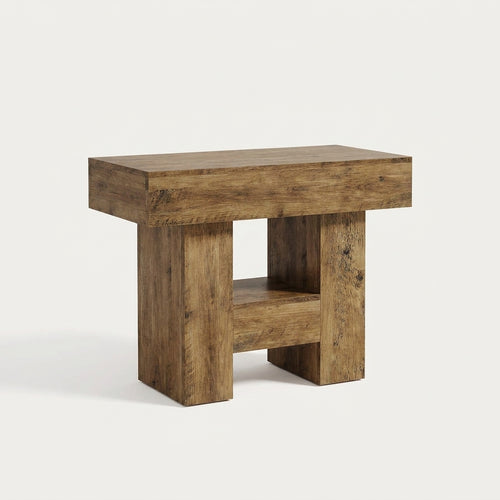
Farmhouse Style with Open Storage
Style rustique · 80 × 30 cm
£255.00
Voir le produit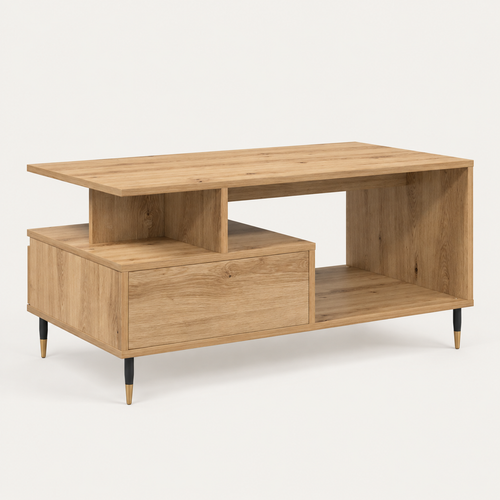
Elegancia natural y líneas depuradas
Oak effect · 90 × 49 cm
£230.00
Voir le produit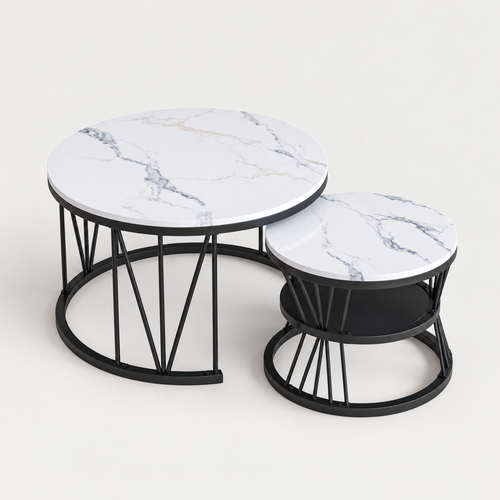
Round Shapes and Sleek Design
Metal frame · set of 2
£277.00
Voir le produit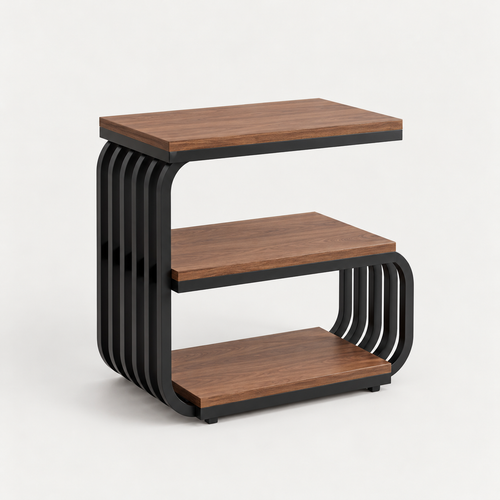
Rustic Wood and Black Metal
Wood and metal effect · 65 × 35 cm
£234.00
Voir le produitWhich sizes free up floor space?
First, compare the actual space each table takes up. Visually, a round table appears smaller than a rectangular one, but it takes up almost as much floor space. According to the dimensions on our product pages, here is how much each occupies.
- An 80 × 30 cm table occupies 0.24 m².
- A 90 × 49 cm table occupies 0.44 m².
- A round table with a diameter of 80 cm occupies 0.50 m².
- A 110 × 50 cm table occupies 0.55 m².
The narrow table, 30 cm deep
This is the most compact solution. Our narrow 2-level coffee table measures 80 × 30 cm. It can be placed in front of a small sofa, along a wall, or at the end of a sofa. Its lower shelf holds books and magazines. Its MDF top, a wood fiber panel, supports up to 45 kg, and its heavy base keeps it stable. Its height is not given in the description. Check the product page before placing it in front of the seat.

The round table with a diameter of 80 cm, easy to walk around
With no corners, it makes it easier to move around the sofa. This is useful for a walkway to the balcony. Our round brown wooden table has a diameter of 80 cm, and its product page recommends it for small or medium-sized living rooms. Its finish resists scratches and stains. It offers 0.50 m² of tabletop, twice as much as the narrow one, but it requires 180 cm of clear width. For its height and base, see the product page. Our guide how to choose a round coffee table compares other diameters.

Nesting tables, two tables when you need them
This is the best size for a living room with changing uses. The two tables store one under the other and are separated when you need more surface area. The set of round nesting tables with a black frame has a large table 45 cm high, and the small one slides underneath. The marble-effect oval nesting tables, with a gold frame, are 41 to 51 cm high and add a lower shelf to each table. The round wooden nesting tables have a more curved volume. For their dimensions, see the product page. Read our guide nesting coffee table to find out how to arrange them.

Glass, a table that is barely visible
Our tempered glass coffee table has a curved S-shaped silhouette and a discreet lower shelf. It lets you see the rug and the floor through it. It takes up as much space as another table on the floor, but it weighs less visually. This is its advantage in a small, dark, or heavily furnished living room. For its dimensions, see the product page, and add them to the walkway calculation.

The lift-top, one table for multiple uses
In a studio or living room without a real dining area, it avoids the need to buy another table. Our oval lift-top table measures 110 × 55.5 cm and goes from 40 to 55 cm high. It hides a compartment 18 cm high and requires 156 cm of clear width. There is also a lift-top with double storage and a walnut-finish lift-top. Our guide how to choose a lift-top coffee table details their limitations.
If you are hesitating between two sizes, take the smaller one and add a small surface next to it. A 3-level table measuring 65 × 35 cm at the end of the sofa does the job very well, as does a pair of nesting tables placed to the side. Two small surfaces well placed serve better than one large table that blocks the walkway.
Notre sélection
Our models to lighten the room or change use
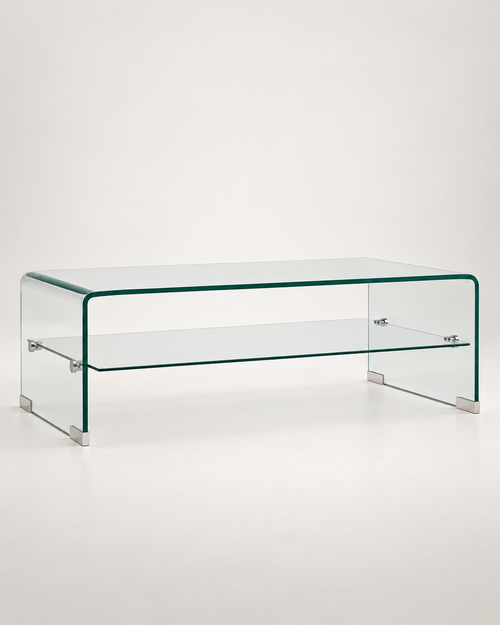
Transparencia escultural y minimalista
Tempered glass · lower shelf
£596.00
Voir le produit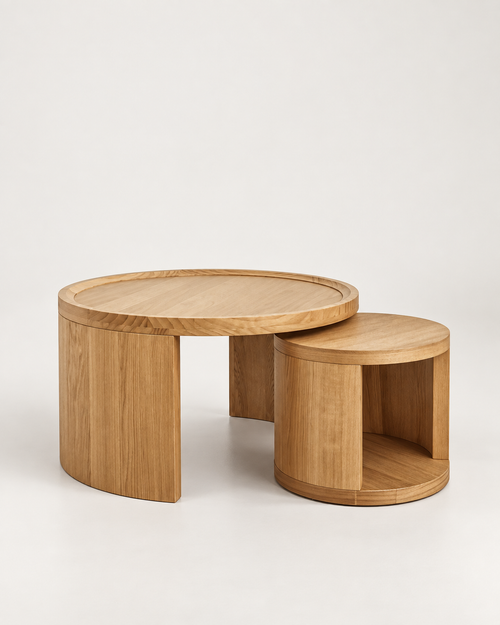
Elegancia Japandi y natural
Wood finish · set of 2
£493.00
Voir le produit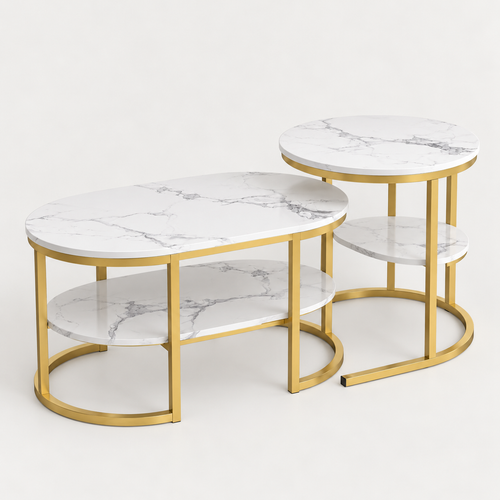
Gold Frame and Storage
Marble effect · 41 to 51 cm high
£225.00
Voir le produit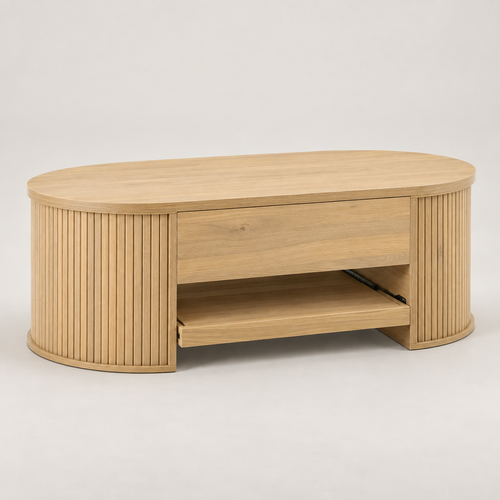
Almacenaje Integrado y Líneas Curvas
Lift-top surface · 110 × 55.5 cm
£281.00
Voir le produitLegs, transparency, color: how to visually lighten the table?
Once the size is chosen, keep a simple principle in mind. The more floor you see, the larger the living room appears. Four details play on this effect.
Visible legs
The floor remains visible under the top. The pair of round tables measuring Ø 80 and 60 cm rests on metal legs, and the round nesting tables on a metal frame. Conversely, a solid table placed on the floor, like the rectangular wood-effect table, is more suitable for a generous room.
Transparency
The eye passes through the table. Tempered glass is the most effective. It keeps this effect if the shelf remains almost empty, with a few books and one object at most.
A color close to the floor
A top close to the tone of your floor blends into the room. According to its product page, the oak-effect table lightens the living room. Walnut is more present and requires a floor or rug that highlights it.
A low top
A table measuring 33.5 to 40 cm high lets the eye pass over it. This is the case of the solid pine table, measuring 33.5 cm, and the walnut-effect round table, measuring 40 cm.
The rug and the light
A single large rug under the table and the front legs of the sofa brings the whole area together. A small rug cuts it up. As for light, avoid a lamp that occupies the entire top. A pendant light moves the lighting upwards, as explained in our guide pendant light for a small living room. A table lamp finds its place better on a side table.
Which table for a 12, 15, or 20 m² living room?
A 12 m² living room
With 3 m wide, a 90 cm sofa and a 40 cm piece of furniture, 170 cm remain. The maximum table depth is therefore 70 cm. The narrow 80 × 30 cm table fits without any problem. The Artisan Oak measuring 90 × 49 cm too, and its product page specifies that it is suitable for a small living room. The round table with a diameter of 80 cm leaves only 50 cm. Reserve it for a space without a piece of furniture opposite.
A 15 m² living room
With 3.30 to 3.50 m wide, you gain 30 to 50 cm. It is from this size that the round table with a diameter of 80 cm and the oval lift-top become comfortable. If the living room also serves as a walkway to the kitchen, count 75 cm instead of 60. With 200 cm clear, the maximum table depth then drops to 85 cm.
A 20 m² living room
It all depends on what the room contains. A 20 m² living room with a dining area behaves like a 12 m² living room. If it is reserved for the sofa, the large sizes return. Look at the round table with a diameter of 85 cm, which supports up to 90 kg, the solid pine table measuring 110 × 50 cm, or the oak-effect table measuring 90 × 60 cm, which its product page recommends for medium-sized living rooms.

Notre sélection
Our models for 180 cm free or more
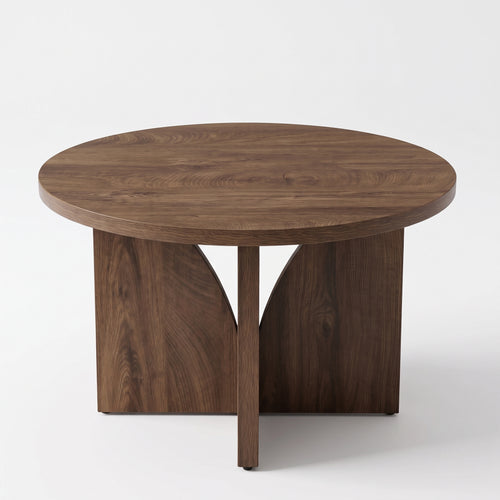
Compact Size and Timeless Lines
Brown wood · Ø 80 cm
£340.00
Voir le produit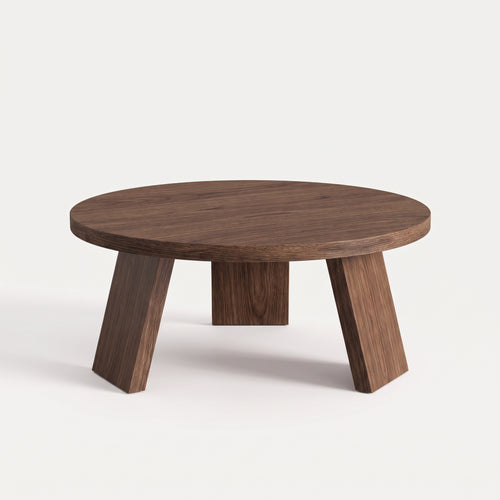
Angled Legs and Vintage Style
Walnut effect · Ø 85 cm
£204.00
Voir le produit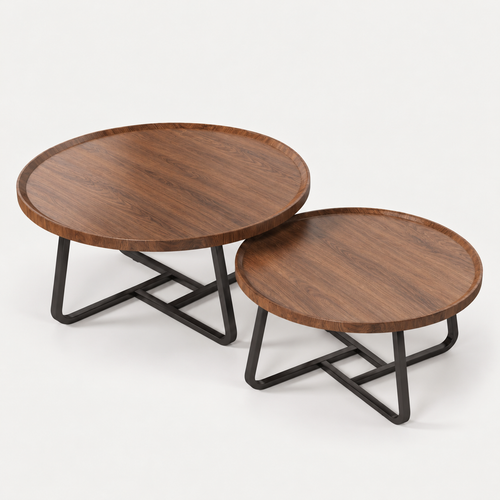
Mid-Century Style and Space-Saving
MDF and metal · Ø 80 and 60 cm
£277.00
Voir le produit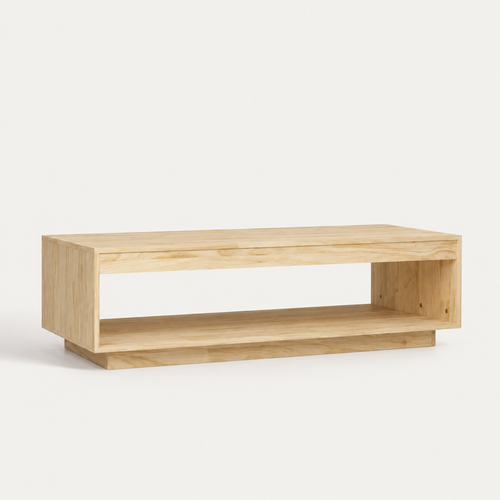
Almacenaje abierto y diseño natural
Solid pine · 110 × 50 cm
£204.00
Voir le produitWhat style for a small table?
Once the size is fixed, the style is chosen according to the rest of the room.
- Japandi, a mix of Japanese and Scandinavian styles: the round wooden nesting tables, with their curved lines, also fit into a Scandinavian or contemporary living room.
- Mid-century, a style inspired by the middle of the last century: the duo of Ø 80 and 60 cm with metal legs, or the round walnut effect with angled legs.
- Minimalist: the round nesting tables with black structure or the tempered glass do not clutter the room.
Three small living rooms, three coffee tables
A 12 m² living room with access to the balcony
The room is 3 m wide and receives a 2-seater sofa. The free width is 170 cm, but the passage to the sliding door crosses the living room and requires 75 cm.
Our choice: the narrow table of 80 × 30 cm, which leaves 100 cm of passage (170 minus 40 minus 30). Add the 3-level side table at the end of the sofa for the lamp, books, and remote controls.
A 15 m² living room where you receive and sometimes dine
The room is 3.40 m wide and the free width is 210 cm. There is no separate dining area. Friends come twice a month and the sofa is often unfolded or moved.
Our choice: the round nesting tables with black structure. The small one comes out when you receive and stores under the rest of the time. Another solution, the oval lift-top of 110 × 55.5 cm, raised to 55 cm for a meal on the sofa.
A 20 m² living room with a dining table
The room is 4.50 m wide. The dining area takes up a third and there is a passage between the dining table and the sofa. You want a light and warm atmosphere.
Our choice: the tempered glass table, which lets you see the rug. For its dimensions, see the product sheet. Check that there is at least 60 cm between the coffee table and each chair pulled back.
The mistakes to avoid
- Choosing based on the surface alone. A narrow 15 m² living room and a square 15 m² living room do not accept the same table. Measure the free width.
- Sacrificing the 60 cm of passage. A table that forces you to pass sideways ends up pushed against the sofa.
- Bringing the table closer than 30 cm to the sofa. You gain passage, but you hit your knees every time.
- Taking the largest round possible. A round of Ø 85 cm requires 185 cm free.
- Overloading a glass table. A full shelf cancels the transparency effect that justifies this choice.
- Forgetting the doors and drawers. A TV stand that opens or a door that pivots reduces the passage you calculated.
Your questions
What coffee table for a small living room?
Take a table of 30 to 50 cm deep if the free width in front of the sofa is 130 to 150 cm. Take a round of Ø 80 cm from 180 cm, and nesting tables below 130 cm. Always check this calculation: table depth + 40 cm gap + 60 cm passage.
What size coffee table for a 12 m² living room?
In a 12 m² living room and 3 m wide, there is often 170 cm left in front of the sofa. This gives 70 cm of table depth maximum. Aim for 80 × 30 cm, 90 × 49 cm or nesting tables. Reserve the round of Ø 80 cm for plans without furniture opposite.
What coffee table for a 15 m² living room?
A set of nesting tables or a lift-top of 110 × 55.5 cm is suitable when there is 170 to 220 cm left in front of the sofa. A round of Ø 80 cm is suitable from 180 cm. If the living room serves as a passage, count 75 cm instead of 60 cm.
What passage width to leave around a coffee table?
Keep at least 60 cm on the other side of the table, and 75 to 90 cm on a main passage. Between the sofa and the table, count 40 to 45 cm.
Round or rectangular coffee table in a small living room?
The round is easier to go around and makes the passage safer, but it takes more depth. A round of Ø 80 cm requires 180 cm free. The narrow rectangular, of 30 to 50 cm deep, remains the most suitable for a long living room.
Is a nesting table practical on a daily basis?
Yes, if you need surface only sometimes. The small one stores under the large one and frees up the floor. Check on the product sheet the height of the large table and the dimensions of the small one.
Does a glass table really enlarge a small living room?
It does not free up floor space. On the other hand, the eye goes through the top and sees the rug, which makes the room lighter. The effect holds if the shelf remains almost empty and if the top is cleaned regularly.
Find the coffee table for your small living room
Do you have your free width? Compare the formats and dimensions on the product sheets.
Free delivery · 30-day returns · Secure payment
