






For a dining room, allow 100 to 200 lumens per m² for the entire room, and 800 to 1,500 lumens above the table for 4 to 6 people. Lumens measure the amount of light. Above the table, this corresponds to an old 60- to 100-W bulb, or 7 to 19 W in LED.
This guide provides the step-by-step calculation, sizes by area, and the right approach for multi-bulb chandeliers. If you already know the area of your room, go directly to the table by area.
What lighting power for a dining room? Lumens, lux, and watts
For a long time, we chose our bulbs by watts. With LED, this approach no longer works. A 10-W bulb can illuminate as much as an old 75-W one. To properly balance the light, you need to distinguish three units.
- Lumens (lm) measure the light emitted by the bulb or LED. This is the figure to read on the packaging.
- Lux (lx) measure the light received by a surface, such as your tabletop. One lux corresponds to one lumen received per m². This is the target to achieve.
- Watts (W) measure the electricity consumed. An LED produces about 80 to 120 lumens per watt. This figure is mainly used to compare consumption.
A practical rule connects the three. For the room, multiply the lumens per m² by the area. Above the table, allow at least twice as many lumens as the lux multiplied by the surface area of the tabletop, because some of the light falls beside it. The method is the same as for a living room, as explained in our guide how many lumens for a living room.
How many lux in a dining room?
A dining room is set up in two zones. The table requires more light, because you look at the dishes, faces, and sometimes children's notebooks there. The rest of the room requires less, because you walk around and are mainly looking for an atmosphere.
- On the table, 200 to 300 lux. This is enough to see the dishes and people clearly, and even to read or work.
- In the rest of the room, 100 to 200 lumens per m². Wall lights and lamps provide this soft light.
- Above a table for 4 to 6 people, 800 to 1,500 lumens. This total includes all the bulbs in the pendant light.
These values correspond to full power. With a dimmer, that is, an intensity setting, you will go well below this for a subdued dinner. The important thing is to have enough light when you need it.
Calculating the power of a dining room light, step by step
Five steps are enough to know how many lumens to allow and how to distribute them.
- Measure the area of the room. Multiply the length by the width. A dining room of 4 × 3 m is 12 m².
- Multiply by 100 to 200. You get the total lumens. For 12 m², this gives 1,200 to 2,400 lm.
- Correct if necessary. Add 20 to 30% if the walls are dark, if the ceiling is over 2.70 m, or if the room contains a lot of materials that absorb light, such as velvet or dark wood.
- Reserve 800 to 1,500 lm for the table. Allow nearly 800 lm for 4 people, and up to 1,500 lm for 6.
- Distribute the rest. Use wall lights, the buffet lamp, and small accent lights, so as not to depend on the pendant light alone.
How many lumens for a dining room of 10, 12, 15, or 20 m²?
Here is the calculation applied to the most common areas, with a table example, the total for the room, and the portion to reserve for the table. The power indicated in LED concerns the entire room.
| Your room | Total for the room | Including the table |
|---|---|---|
|
10 m² Round table Ø 90 cm, 4 people |
1,000 to 2,000 lm About 8 to 25 W in LED |
About 800 lm |
|
12 m² Round table Ø 110 cm, 4 to 5 people |
1,200 to 2,400 lm About 10 to 30 W in LED |
About 800 to 1,000 lm |
|
15 m² Table 160 × 90 cm, 6 people |
1,500 to 3,000 lm About 13 to 38 W in LED |
About 1,500 lm |
|
20 m² Table 180 × 90 cm, 8 people |
2,000 to 4,000 lm About 17 to 50 W in LED |
1,500 lm and more, on 2 or 3 pendant lights |
On a small area, the pendant light provides most of the light. On 20 m², it only provides a part of it. If your walls are forest green, if your woodwork is dark, or if your ceiling is 3 m, apply the correction of 20 to 30%. A 15 m² room then goes from 1,500 to 3,000 lm to about 1,800 to 3,900 lm.
See all pendant lights and all chandeliers
What power for the pendant light above the table?
The table is the area that requires the most light, namely 800 to 1,500 lumens for 4 to 6 people, regardless of the number of luminaires. A table for 4 people is satisfied with about 800 lm, the equivalent of a 60-W incandescent bulb. A table for 6 people goes up to 1,500 lm, the equivalent of a 100-W.
| Light emitted | Old bulb and LED | Use in the dining room |
|---|---|---|
| 250 lm | About 25 W 2 to 3 W in LED |
Candle of a multi-bulb chandelier, small accent lamp |
| 470 lm | About 40 W 4 to 6 W in LED |
A pendant light from a series of three, a wall light |
| 806 lm | About 60 W 7 to 10 W in LED |
Pendant light alone for a table of 4 people |
| 1,055 lm | About 75 W 9 to 13 W in LED |
Table of 4 to 6 people |
| 1,521 lm | About 100 W 13 to 19 W in LED |
Table of 6 people, or total of a series of pendant lights |
If you have several pendant lights, divide the total. Two pendant lights above a table for 6 people share 1,500 lm, or about 750 lm each. Three pendant lights of 470 lm, or about 40 W, give 1,410 lm. To choose the configuration itself, read our guide what luminaire above a dining table.

Multi-bulb chandeliers and pendant lights: add them up
With several bulbs, the total light is the sum of each. This is where we most often make mistakes, one way or another. Here are a few examples, to be adapted according to the bulbs you choose.
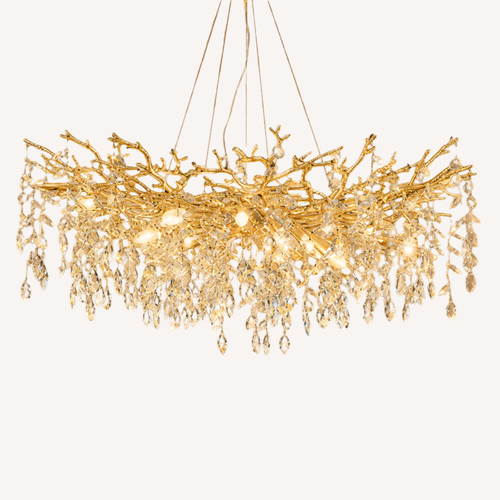
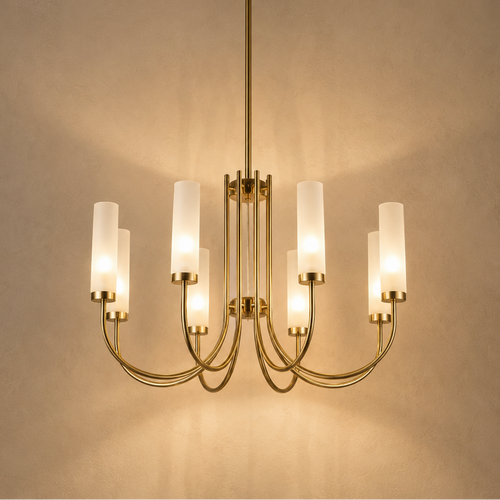
- Sylvara chandelier, 6 bulbs. With six E14 bulbs of 250 lm, you get 1,500 lm, or the amount suitable for a table of 6 people. The bulbs are to be purchased separately.
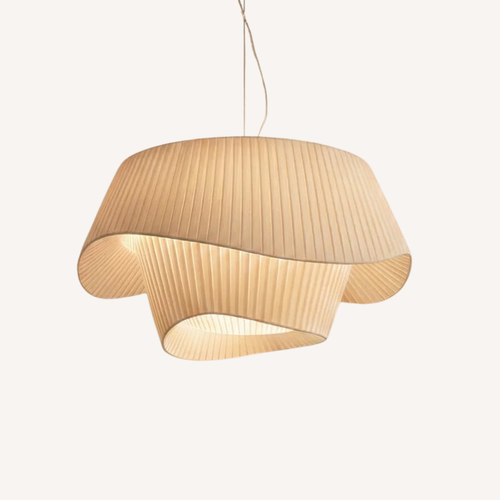
- Nuvora pendant light, 4 or 5 bulbs. In Ø 50 cm, four bulbs of 250 lm give 1,000 lm. In Ø 60 cm, five bulbs give 1,250 lm, or 2,350 lm with bulbs of 470 lm set to a dimmer.
- Lucerna chandelier, 8 to 12 candles. Even with small bulbs of 250 lm, eight candles total 2,000 lm. This chandelier therefore requires a dimmer. Do not exceed 25 W per bulb.
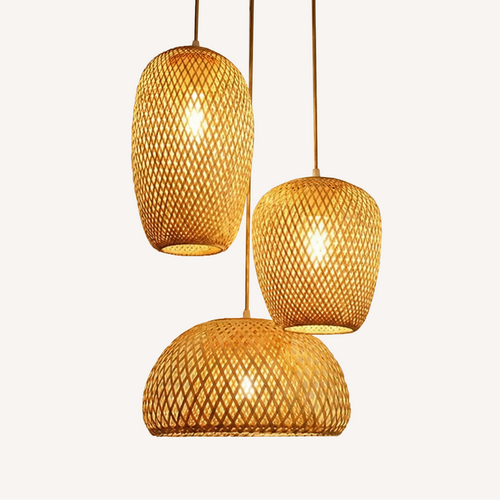
- Doréa triple pendant light. It has three shades, so three E27 bulbs to be purchased separately. Three bulbs of 470 lm make 1,410 lm.


On a multi-bulb luminaire, prefer several small soft sources to excessive power. Allow plenty, then lower with the dimmer. A light that is too strong can be reduced, while a light that is too weak cannot be increased.
Notre sélection
Our multi-bulb luminaires
A bright room of 12 m²
The table is round, Ø 110 cm, for 4 to 5 people, and the walls are white. The calculation gives 1,200 to 2,400 lm in total, without correction. Allow about 1,000 lm above the table, and the rest for the atmosphere.
Our choice: the Nuvora pendant light in Ø 50 cm, with 4 bulbs of 250 lm, or 1,000 lm. Add the Biséil wall light, with its 10 W LED, or about 800 to 1,200 lm. The total reaches about 1,800 to 2,200 lm, within the range.
A room with dark walls of 15 m²
The table measures 160 × 90 cm, for 6 people, and the walls are forest green. The calculation gives 1,500 to 3,000 lm, to be corrected by 20 to 30% because of the dark walls, or about 1,800 to 3,900 lm. Allow about 1,500 lm above the table.
Our choice: the Nuvora pendant light in Ø 60 cm, with 5 bulbs of 470 lm, or 2,350 lm, on a dimmer. Add two Globéil wall lights with E27 bulbs of 470 lm. The total reaches 3,290 lm at full power.

Notre sélection
Our wall lights to complete the light

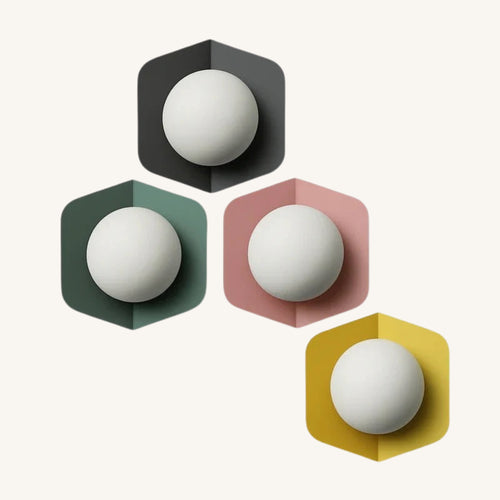
How to read the power of an LED luminaire
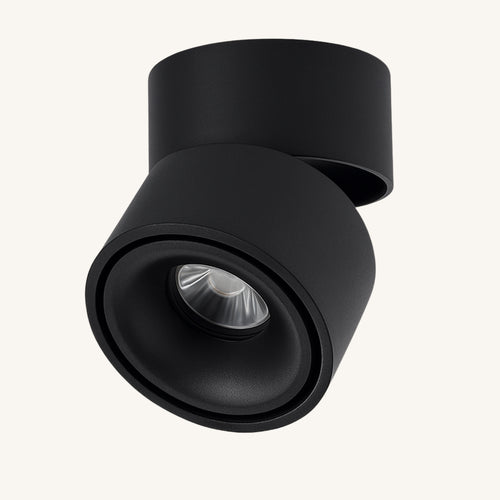
On a luminaire with integrated LED, the sheet often indicates watts rather than lumens. Multiply them by 80 to 120 to estimate the light emitted. A 10-W wall light gives about 800 to 1,200 lm, and a 7 to 15-W spotlight about 560 to 1,800 lm.
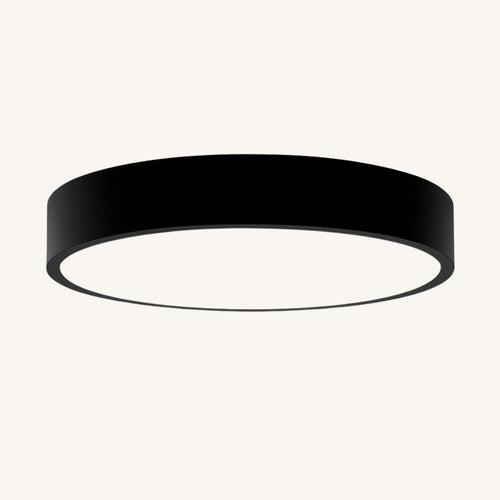
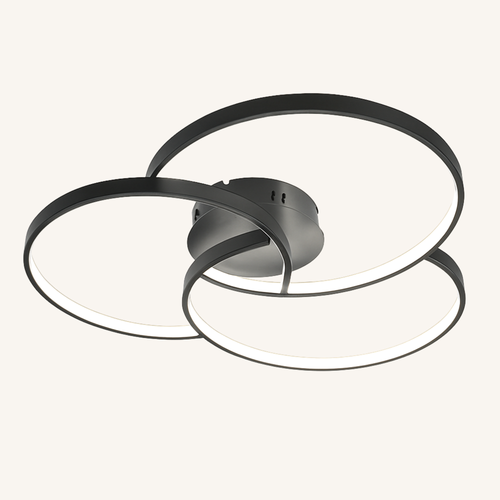
A ceiling light that goes up to 76 W, like the Rosélis, far exceeds the needs of a dining room of standard size. Its adjustable intensity makes it especially useful in a very large room.

Notre sélection
Our spotlights and ceiling lights to complete the room
Dimmer, 2700 to 3000 K, and CRI: how to choose the quality of the light?
Having enough lumens is not enough. A powerful but cold or dull light spoils a dinner. Three settings make the difference.
- The color temperature. It is measured in Kelvin (K). The lower the number, the warmer the light. Take 3000 K for a dining room, or 2700 K for a more intimate atmosphere. Keep the same throughout the room, with a maximum difference of 300 K. Our comparison 2700K or 3000K helps you choose.
- The color rendering index (CRI). It indicates if the light respects the colors. Take 80 at minimum, and 90 or more if possible, so that the dishes, the wine, and the faces keep their true colors.
- The dimmer. It takes 1,500 lm of work light to a subdued late-evening light. Check that each bulb or LED is clearly indicated as dimmable, that is, compatible with a dimmer.
To organize the entire room around these figures, from the table to the wall lights, read our guide what luminaire for a dining room.
Power of a dining room luminaire: mistakes to avoid
- Reasoning in watts. With LED, only lumens indicate how much light you will have.
- Forgetting to add up. Six bulbs of 470 lm make 2,820 lm, almost twice what is needed for a table of 6 people.
- Asking everything of the pendant light. On 20 m², it cannot provide alone 2,000 to 4,000 lm without dazzling.
- Neglecting dark walls. They absorb light. Add 20 to 30%.
- Doing without a dimmer. A power adapted for the household is too strong for a dinner.
Your questions
What lighting power for a dining room?
Allow 100 to 200 lumens per m² for the entire room and 800 to 1,500 lumens above the table for 4 to 6 people. In LED, this represents only 7 to 19 W for the table pendant light.
How many lumens above a dining table?
Allow about 800 lumens for a table of 4 people and up to 1,500 lumens for a table of 6 people, or 200 to 300 lux on the tabletop. If you have several pendant lights, this total is distributed among them.
How many lux are needed in a dining room?
Allow 200 to 300 lux on the table, or 800 to 1,500 lumens above a table of 4 to 6 people. For the rest of the room, allow 100 to 200 lumens per m².
How many lumens for a 15 m² dining room?
Plan for a total of 1,500 to 3,000 lumens, including about 1,500 above a table for 6 people. With dark walls or a ceiling higher than 2.70 m, add 20 to 30%.
What is the lumen equivalent of a 60 W bulb?
An old 60 W incandescent bulb produces about 806 lumens. With LEDs, you get this light with about 7 to 10 W, because an LED produces 80 to 120 lumens per watt.
Is a dimmer needed in a dining room?
Yes, it is highly recommended. The same pendant light should illuminate homework at full power and a dinner in soft light. Choose bulbs or LEDs marked as dimmable, meaning compatible with a dimmer.
Find the right light for your dining room
Do you know the area of your room? Compare pendant lights, chandeliers, and wall lights on the product pages.
View pendant lights and chandeliers
Free delivery · 30-day returns · Secure payment
