






For a warm living room, choose a very warm white light at 2700 K. Spread 3 to 5 light sources at different heights, rather than using a single ceiling light. Opt for natural materials that filter the light, such as paper, fabric, rattan, or travertine.
This guide details our 7 lighting design rules, then three complete settings with the luminaires to create them. If you want to get straight to the results, skip directly to the three settings.
What lighting for a warm living room?
Start with the color of the light. This is the rule that makes the biggest difference, and the least expensive to apply.
Rule 1: choose a very warm white, 2700 K everywhere
Color temperature is expressed in kelvins (K). It indicates whether a light leans towards yellow-orange or blue. In a living room, aim for 2700 K, the color of old incandescent bulbs, which enhances wood, fabrics, and faces.
- One color per room. Keep a maximum difference of 300 K between your light sources. A 3000 K reading lamp, such as the Liséa floor lamp, matches bulbs at 2700 K. A 4000 K ceiling light does not match them.
- On adjustable models, choose the warmest color. The Sérune lamp comes with an E27 bulb with 3 color temperatures. The Soléa lamp also offers 3 light colors.
- A CRI of 90 or higher. The Color Rendering Index (CRI) indicates whether colors remain true under the light. At 90 or higher, wood, cushions, and skin retain their true colors.
This article is about the living room and the choice of luminaires. For principles applicable throughout the home, read our 2026 guide to creating a warm atmosphere with light. If you are still unsure about the color, our comparison of 2700K or 3000K for a living room helps you choose according to your room.
How many light sources and where to place them?
Rule 2: multiply low light sources
A light falling from the ceiling illuminates the tops of things. A light placed at eye level or lower illuminates people, materials, and walls. This is what makes the room intimate. Plan for 3 to 5 light points, spread across three heights.
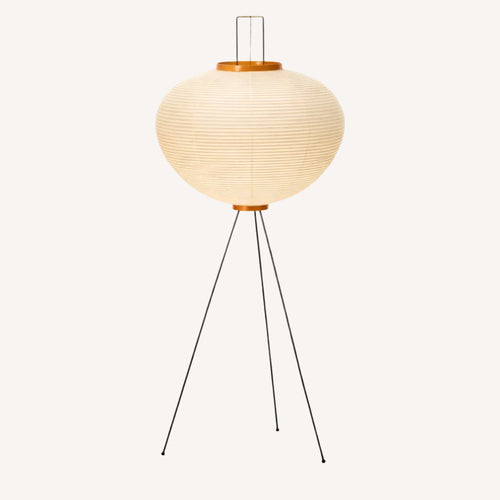
- On the floor. A floor lamp, such as the Lumaro floor lamp with its 53 cm rice paper globe, illuminates a corner of 10 to 15 m² on its own.
- At mid-height. Place lamps on the console, sideboard, or end table. Add wall lights placed at 1.60 or 1.80 m from the floor.
- On the ceiling. A pendant light or ceiling light provides the overall light.

This layering is called layered lighting. We detail it step by step in our layered lighting guide. In the living room, remember that you need at least one source per height.
Rule 3: arrange the sources in a triangle
Three beautiful lamps grouped in the same corner create an island of light and leave the rest of the room in shadow. Spread your low sources in a triangle. The gaze moves from one to another, the shadow areas remain soft, and the room appears larger.
Start from the sofa. Place the floor lamp at one end, a table lamp on the piece of furniture opposite, then a wall light or a second lamp on the darkest side. Our guide what luminaire for a living room offers complete plans for three living room sizes.
What materials to filter the light?
Rule 4: filter the light with natural materials
A bare bulb dazzles and creates harsh shadows. Filtered by a material, the same light becomes soft. Each material gives a different result, to choose according to the effect you are looking for.
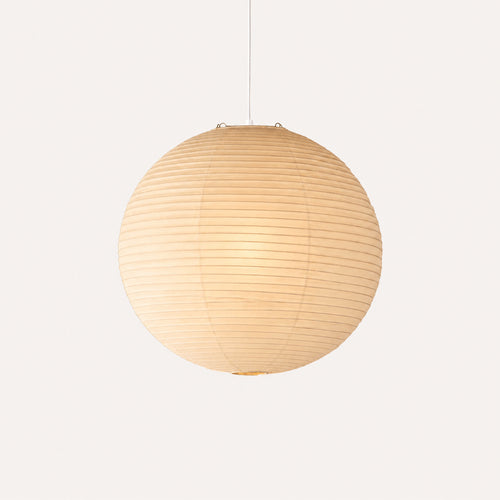
- Paper gives a diffused light, without glare. It diffuses a regular halo in all directions. Look at the Sérora pendant light, the Lumaro floor lamp, and the Sérune lamp.
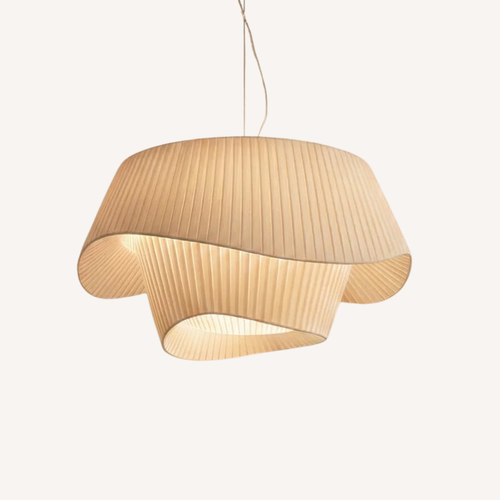
- Fabric gives a soft light. It lets the light filter through and sends it mostly upwards and downwards. Look at the Nuvora pleated fabric pendant light and the Linuna lamp with its ivory pleated shade.
- Rattan projects light patterns on the walls. The Doriro floor lamp in openwork woven rattan is a good example.
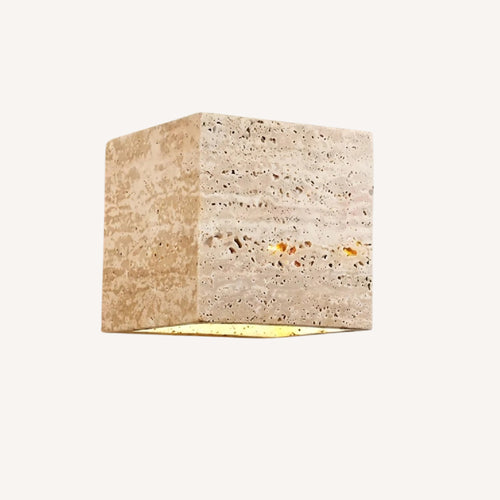
- Travertine, an opaque natural stone, directs the light downwards and warms with its material. The Travénoir lamp combines a travertine base with transparent or tinted glass.

Notre sélection
Our models for filtered light

How to dim the light in the evening?
Rule 5: install a dimmer or choose adjustable luminaires
The same room can be practical at 6 p.m. and intimate at 10 p.m., if you can lower the intensity. The dimmer, the device that adjusts the power of the light, is the best investment for a warm living room lighting. It requires compatible bulbs or LEDs, so check the dimmable mention.
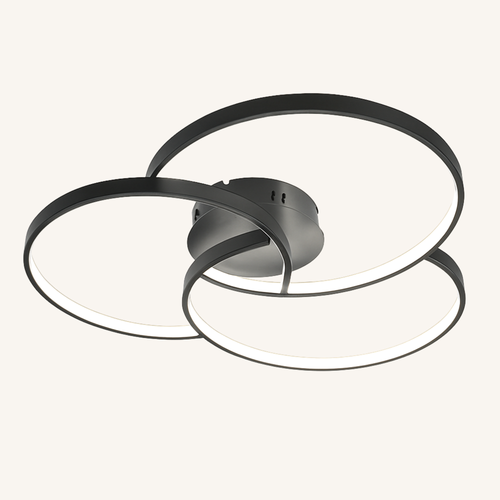
- Dimmable ceiling lights. The Rosélis ceiling light, in Ø 58, 74, or 90 cm, goes from a strong light to a soft glow.
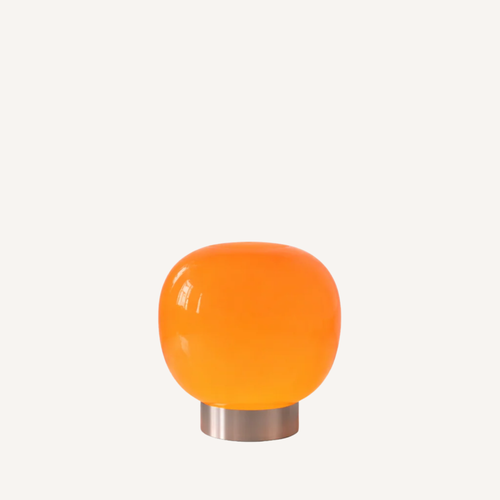
- Wireless lamps. The Solar lamp, rechargeable, offers 9 levels of brightness and moves from the console to the coffee table. Read our rechargeable wireless lamp guide.

Notre sélection
Our models for adjusting the light without a wall dimmer
Rule 6: turn off the ceiling light in the evening
This is the simplest and most effective gesture. The ceiling light remains useful for cleaning, storage, or a lively dinner. Lit alone in the evening, it flattens volumes and gives a harsh light. In the evening, turn it off and let the low sources work.
During the day, turn on the ceiling light or the pendant light, at full intensity if necessary. Add a reading lamp for reading, with about 300 lux, the unit that measures the light received on a surface. Complete with accent lamps according to the natural light.
In the evening, keep the ceiling light off or at the minimum of the dimmer. Turn on the floor lamp, the lamps, and the wall lights, then an accent source on a shelf or a painting.
Why add indirect lighting?
Rule 7: add a touch of indirect light
The softest light is the one whose source you do not see. Directed towards a wall or the ceiling, it returns into the room without harsh shadows. It also gives relief to textures, such as a lime plaster, bricks, paneling, or a bookcase.
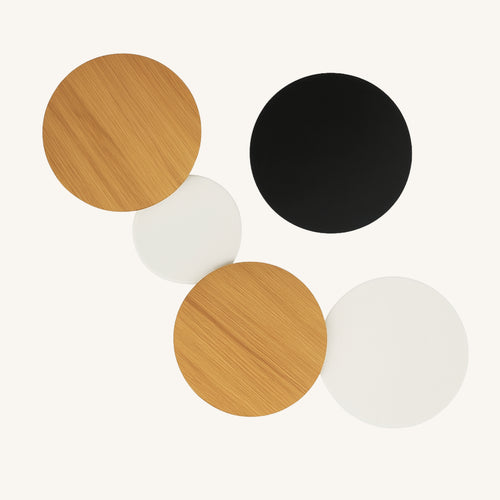
- The wall halo. The Eclipséil wall light hides its source behind a disk and draws a halo on the wall. It is available in white, in Ø 20 cm.
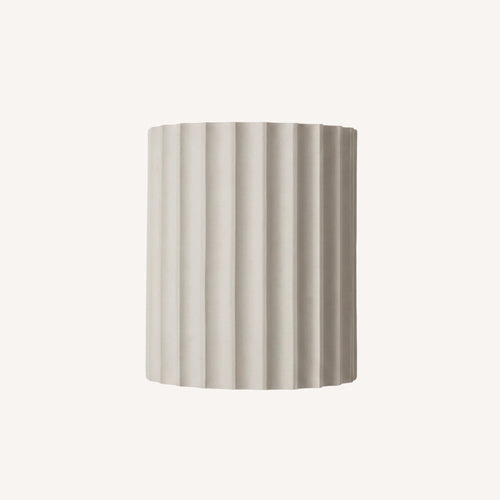
- The light up and down. The Siléil ribbed resin wall light sends two beams that elongate the wall.
- The oriented accent. Turn the spotlights of the Rampélis bar towards a bookcase or a painting, rather than towards the sofa. Their GU10 bulbs are supplied in neutral light. To stay within the 300 K rule, replace them with warm white GU10 bulbs.

Notre sélection
Our wall lights for indirect lighting
Do this test one evening. Turn everything off, then turn on one source at a time, starting with the lowest. Stop when the room seems welcoming to you. You will know which lamps to keep lit in the evening, and which are only useful during the day.
Should a warm living room be dark?
No. Warming up a living room does not mean plunging it into the shadows, because we read, play, and receive there. The amount of light is calculated in lumens, the unit of light emitted by a source. It is spread across all sources, and watts are not enough to compare it.
- The color. 2700 K, with a difference of 300 K at most between the sources.
- The number of sources. 3 to 5 light points, spread on the floor, at mid-height, and on the ceiling.
- The quantity. 150 lumens per m² on average in total, with a range of 100 to 200. This makes 3,000 lumens for 20 m².
Add 20 to 30 % if your walls are dark, if your ceiling exceeds 2.70 m, or if the room contains a lot of materials that absorb light, such as velvet, thick rugs, or dark wood. For the step-by-step calculation, with examples by surface, read our guide how many lumens for a living room.
Warm living room lighting: three complete settings
Here are three complete compositions, each built around a family of materials. Keep only one per room, because coherent materials make up a large part of the atmosphere.
| Atmosphere | On the ceiling and on the floor | Lamp and wall |
|---|---|---|
|
Natural Japandi Paper, rattan, light wood, linen |
Sérora, then Lumaro or Doriro | Sérune, Eclipséil |
|
Warm mineral Travertine, wood, fabric |
Travéaube, then Argiro | Travénoir, Luminosa |
|
Retro 70s Lacquered metal, opaline glass, colors |
Solora, then Aurélo | Soléa, Fuméil |
A natural Japandi living room of 18 m², with white walls and light parquet
Japandi mixes Japanese and Scandinavian styles. This room is bright during the day and appears cold in the evening. Aim for 1,800 to 3,600 lumens in total, at 2700 K, filtered by paper and natural fibers. Also look at our rattan collection.
Our choice: the Sérora pendant light in Ø 50 cm above the coffee table, then the Lumaro floor lamp at the end of the sofa. Add the Sérune lamp on the console and the white Eclipséil wall light on the opposite wall.
A mineral living room of 22 m², with a dining area and taupe walls
Dark walls absorb light. Plan for 20 to 30 % more lumens than the basic range, which is 2,200 to 4,400 lumens. Travertine brings warmth and fabric softness. See our travertine collection.
Our choice: the Travéaube pendant light above the dining area, then the Argiro floor lamp near the armchair. Add the Travénoir lamp on the sideboard and two Luminosa wall lights on each side of the sofa.

A retro living room of 16 m², with olive green walls and vintage furniture
The colors are already warm. The generous shapes fit well here, such as mushrooms, stacked disks, and opaline globes. Aim for 1,600 to 3,200 lumens, at 2700 K. See our Scandinavian and retro collection.
Our choice: the Solora pendant light in Ø 33 cm, in one of its 4 colors, then the Aurélo floor lamp and its 3 opaline globes. Add the Soléa lamp on the shelf and the Fuméil wall light with tinted glass globe. For the Solora and the Fuméil, the bulb is not supplied.

The mistakes that cool down a living room
- A 4000 K or higher bulb. This neutral white is suitable for an office. In a living room, it makes the room feel cold.
- Mixing whites. A 2700 K lamp next to a 4000 K ceiling light creates an unharmonious result.
- The ceiling light alone, at full power. It flattens volumes and hardens facial features.
- Bare bulbs in the field of vision. Opt for a paper, fabric, or opal glass diffuser.
- All the lamps in the same corner. Spread them out in a triangle.
- Too many different materials. Paper, chrome, crystal, and rattan together blur the atmosphere. Stick to two or three families at most.
Your questions
What lighting for a warm living room?
Warm living room lighting combines a very warm 2700 K white light, 3 to 5 sources spread at different heights, and diffusers made of natural materials, such as paper, fabric, rattan, or travertine. In the evening, turn off the ceiling light and keep the lamps, the floor lamp, and the wall lights.
What color temperature for a cozy atmosphere?
2700 K, very warm white, is the standard for a cozy living room. Keep the same shade across all sources, with a maximum difference of 300 K. Avoid 4000 K and above in living spaces.
How many lamps are needed in a warm living room?
Count 3 to 5 light points depending on the area, for example, a pendant light, a floor lamp, a table lamp, and a wall light. Place them at three heights—on the floor, at mid-height, and on the ceiling—and in a triangle in the room.
How to make a living room warm without a ceiling light?
A floor lamp near the sofa, two table lamps, and a wall light are enough to light a living room without a ceiling light. Aim for 100 to 200 lumens per m² in total. Choose paper, fabric, or rattan shades for soft light.
What lighting fixtures for a cozy and natural living room?
A paper pendant light, a globe or woven rattan floor lamp, a pleated shade lamp, and a halo wall light form a cohesive set. Stick to two or three materials, such as paper, rattan, light wood, or linen.
Should a warm living room be dimly lit?
No. Warmth comes from the 2700 K shade and the distribution of light. Plan for 100 to 200 lumens per m² in total, plus 20 to 30% if your walls are dark. Use a dimmer to lower the light in the evening.
Warm up your living room
Have you chosen your atmosphere? Compare floor lamps, table lamps, wall lights, and pendant lights on the product pages.
View all our lighting fixtures
Free delivery · 30-day returns · Secure payment
