






To choose the size of your ceiling light, add the length and width of the room in meters, then multiply by 8. The result is the maximum recommended diameter, in centimeters. A 4 × 3 m bedroom can therefore accommodate 56 cm at most. In practice, a flat model measuring 35 to 45 cm is sufficient in this room.
This guide gives you the formula, the guidelines by area and room, and then the adjustments according to the ceiling height and the shape of the room. If you already know your area, go directly to the table by room.
How to choose the size of your ceiling light?
Decorators use a simple rule, which we have adapted to the metric system. Add the length and width of the room in meters, then multiply the result by 8. You get the maximum recommended visual diameter, in centimeters.
Take a 4 × 3 m bedroom. 4 + 3 = 7, and 7 × 8 = 56. The ceiling light should therefore not exceed 56 cm in diameter.
This formula has an advantage over a simple calculation by area. It takes into account both dimensions of the room. A narrow room and a square room of the same area will therefore not give the same result.
A maximum not to be exceeded
The formula sets an upper limit. Beyond that, the light fixture dominates the room. Below that, it all depends on the type of light fixture you choose.
A flat and diffusing ceiling light illuminates with its entire surface. It can therefore remain well below the formula. A decorative pendant light occupies the volume of the room and can approach the limit. This is why you should always compare the result of the formula with the guidelines by area that follow.
Also think about passage. Where people walk, ideally keep 2.10 m clear under the light fixture, and 2.00 m at minimum.
What size of ceiling light according to the area and room?
To make it quicker, here are the guidelines by area. They apply to a round or square ceiling light, in a room with classic proportions.
- Less than 10 m² (entrance, bathroom, small office): 25 to 35 cm.
- 10 to 15 m² (bedroom, kitchen): 35 to 45 cm.
- 15 to 20 m² (large bedroom, small living room): 45 to 55 cm.
- 20 to 30 m² (living room, lounge): 55 to 70 cm, or a ceiling light complemented by other light sources.
- More than 30 m²: 70 cm and more, or several light points.
Each room also has its constraints, such as a door that opens, a worktop to illuminate or a bed from which you look at the ceiling. The table below brings together the size, the light level and the point to check.
Two units come back. Lux measures the amount of light that reaches a surface. Kelvin (K) indicates the color of the light, and the lower the number, the warmer the white.
| Your room | Recommended diameter | Light and point to check |
|---|---|---|
|
Entrance 4 to 8 m² |
25 to 35 cm | 100 to 150 lux, 3000 K. Bottom of the light fixture at 2.00 or 2.10 m at least. Check the opening of the door. |
|
Hallway 1 m × 4 to 6 m |
25 to 30 cm, or small models in series | 50 to 100 lux. One source every 2 to 3 m. |
|
Bedroom 10 to 15 m² |
35 to 45 cm | 100 to 200 lux, 2700 K. An opal diffuser avoids being dazzled from the bed. |
|
Kitchen 10 to 15 m² |
35 to 45 cm | 200 to 300 lux, 3000 K. Complete on the worktop, with 300 to 500 lux. |
|
Living room 20 to 30 m² |
55 to 70 cm | 100 to 200 lux, 2700 K. Add 2 to 3 auxiliary sources. |
|
Bathroom 4 to 8 m² |
25 to 35 cm | 200 to 300 lux, 3000 K. Model designed for a damp room. At the mirror, 300 to 500 lux. |
What size for an entrance?
In the entrance, size matters less than height. Keep at least 2.00 to 2.10 m under the light fixture and check that the door opens freely. A 30 cm model is sufficient in most cases. Our guide what light fixture for an entrance details the possible configurations.

What size for a hallway?
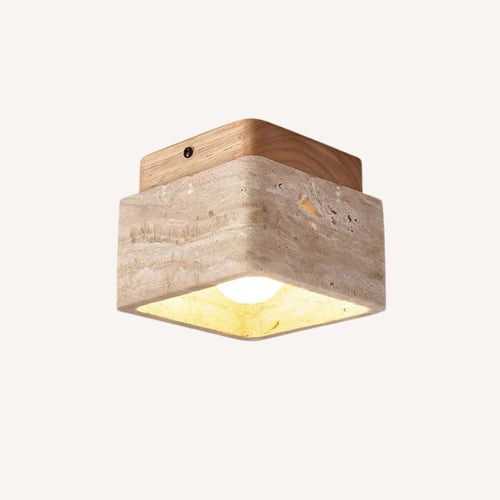
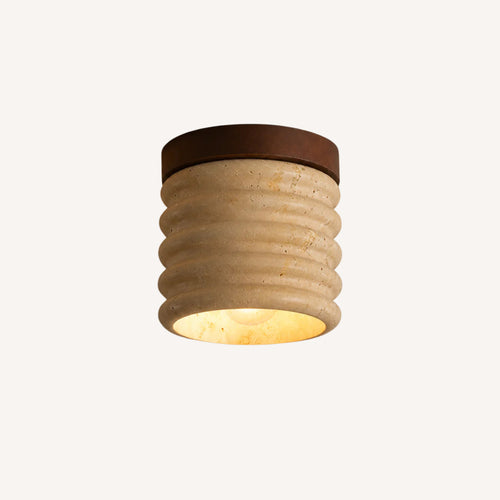
In a hallway, the formula does not apply as is. A 5 × 1 m hallway would give 48 cm, which is far too much for a narrow passage. Prefer several small ceiling lights in series, with a source every 2 to 3 m, or wall lights. Read our guide what light fixture for a hallway to compare these solutions.

Notre sélection
Our small models for a hallway or a dressing room
What size for a bedroom or a kitchen?
In a 10 to 15 m² bedroom, 35 to 45 cm is sufficient. We look for soft light there, complemented by wall lights or bedside lamps.
In a kitchen of the same area, the size is identical, but you need more light. Choose a ceiling light that gives a lot of lumens, the unit that measures the amount of light emitted by a light fixture. Then add lighting reserved for the worktop.

What size for a living room or lounge?
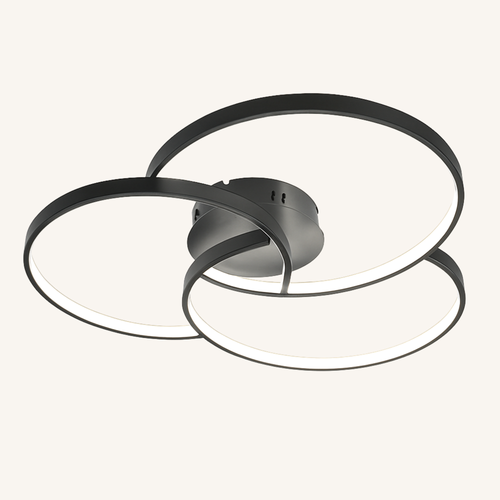
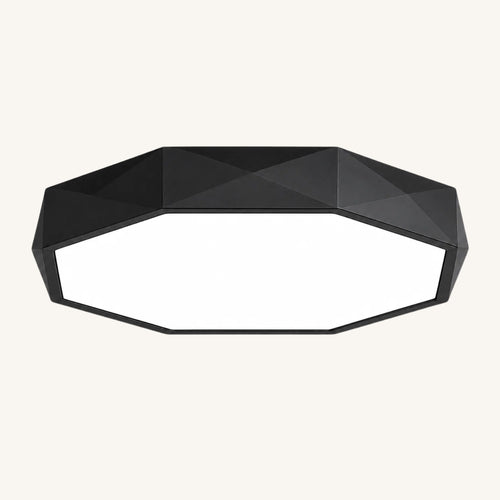
This is the room where we most often choose too small. For a 20 to 30 m² living room, aim for 55 to 70 cm, and always plan other light sources around. The most common case, the 20 m² room, is treated in detail in our guide what ceiling light for a 20 m² living room.

Notre sélection
Our models for a living room or living area
And in a bathroom?
The size guidelines are those of a small room, i.e. 25 to 35 cm for 4 to 8 m². For your safety, choose a model designed for damp rooms. Check this point on the product sheet before ordering, and plan stronger light at the level of the mirror.
What thickness of ceiling light according to the ceiling height?
The diameter is chosen with the area. The thickness is chosen with the ceiling height. A ceiling light too thick under a low ceiling crushes the room, even if it does not hinder passage.
Less than 2.40 m
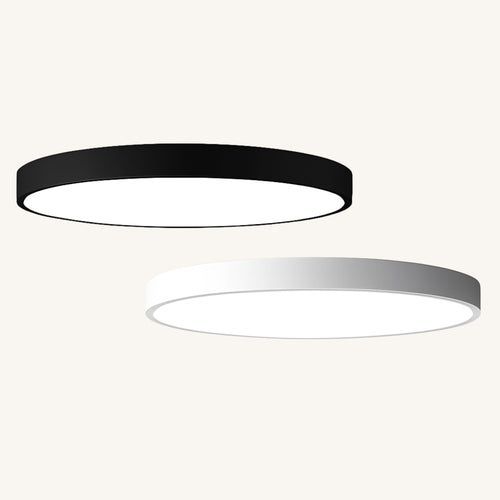
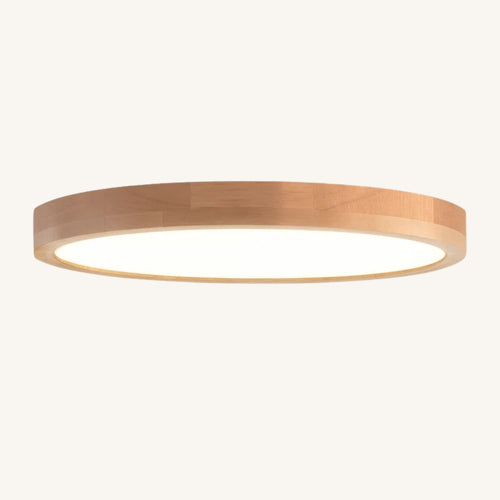
Take an extra-flat ceiling light of 10 cm maximum, and ideally 5 to 8 cm. Choose a wide diffusion, with frosted glass, opal or acrylic. The Orbélis ceiling light is 5 cm thick and the Octélis 6 cm. All our advice is in the guide what light fixture for a low ceiling.

Notre sélection
Our models for a low ceiling
2.50 m, the standard height
In a passage area, the total bulk of the light fixture should not exceed 40 to 50 cm. A ceiling light, even with relief, therefore passes without difficulty.
More than 3 m
The central light fixture can measure 20 to 25 % of the ceiling height, i.e. 65 to 80 cm high for 3.20 m. Keep 2.10 to 2.30 m of passage underneath. Under such a high ceiling, a flat ceiling light looks lost. Prefer a pendant or a chandelier.
Round, square or rectangular: what shape of ceiling light according to the room?
The shape of the ceiling light must follow that of the area it illuminates. The rule is simple, and yet it is the most common mistake in elongated rooms.
Square or almost square room
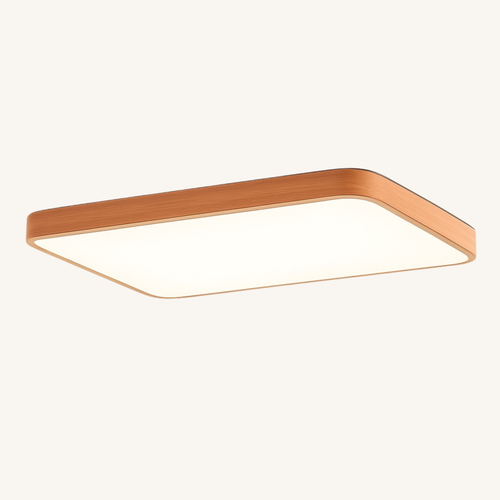
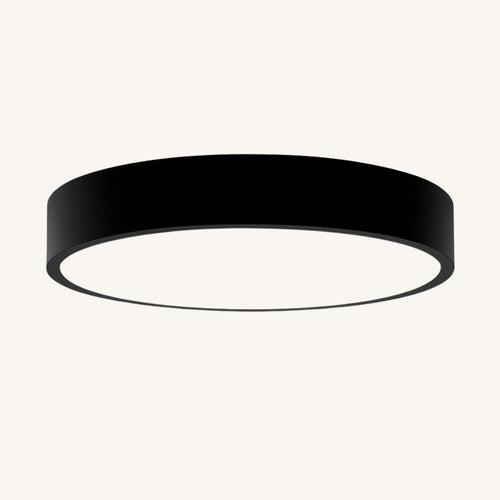
A round or square ceiling light sends light evenly towards the four walls. The round softens a room with straight lines. The square highlights a more graphic architecture, like the Rectélis ceiling light in 30 × 30, 40 × 40 or 50 × 50 cm.
Elongated room
A rectangular ceiling light, placed in the direction of the length, stretches the light to the ends. The Rectélis in 60 × 40 or 80 × 60 cm suits bedrooms and living rooms longer than wide. For a rectangular format, compare its large side to the result of the formula.

Notre sélection
Our round, square or rectangular models
Large room or elongated room: one or several ceiling lights?
Beyond 30 m², or as soon as a room is twice as long as wide, a single ceiling light reaches its limits. Either it is too small for the room, or it becomes oversized. The solution consists in dividing the room into zones and applying the formula to each.
The same reasoning applies to an L-shaped living room or a dual-use room, such as a living room with a dining room. Plan one light fixture per living area, at the right size for its area. In an open room, keep the same family of shapes or finishes so that the whole remains coherent.
How to measure before buying?
Five steps are enough, and they only require a tape measure and a piece of cardboard.
- Measure the length and width of the room on the floor, in meters. For an L-shaped room, measure each area separately.
- Measure the ceiling height. It decides the maximum thickness of the ceiling light.
- Do the calculation. Add the length and width, multiply by 8, then compare with the guideline by area. The right size is in the range, without exceeding the formula.
- Locate the light point. Look if it is centered on the room or on the living area. In an entrance, also check the opening of the door.
- Test with a template. Cut out a cardboard disk at the target diameter and fix it to the ceiling for a few minutes. You will see right away if the size suits you.
If you hesitate between two sizes, take the larger one if it remains below the formula. A ceiling light too small is the mistake that is regretted most often. A dimmer, the device that allows to lower the light, easily attenuates a large ceiling light. A model too small, it cannot be made up.
Three rooms, three calculations
A 4 × 3 m bedroom, i.e. 12 m², with a 2.50 m ceiling
The calculation gives (4 + 3) × 8 = 56 cm maximum. The guideline for 10 to 15 m² is 35 to 45 cm. You want a soft light, that does not dazzle from the bed.
Our choice: the Sylvélis ceiling light in Ø 40 cm, ultra-thin, with adjustable intensity. Complete it with two wall lights at the bedside.
An entrance of 2.5 × 2 m, i.e. 5 m², with a 2.35 m ceiling
The calculation gives (2.5 + 2) × 8 = 36 cm maximum. The guideline under 10 m² is 25 to 35 cm. The ceiling is low, so the thickness must not exceed 10 cm, and the door must pass under it.
Our choice: the Octélis ceiling light in 30 cm, with its 6 cm thickness. For a touch of wood, take the Rectélis ceiling light in 30 × 30 cm.
An elongated living room of 8 × 4 m, i.e. 32 m², with a 2.50 m ceiling
With a single ceiling light, the calculation gives 96 cm maximum, which is too massive. With two areas of 4 × 4 m, each area accommodates 64 cm at most, and the guideline for 16 m² is 45 to 55 cm.
Our choice: two Orbélis ceiling lights in Ø 50 cm, one per area. Add a floor lamp for reading next to the sofa.
See the wall lights to complete the ceiling light
The size mistakes to avoid
- Choosing too small. This is by far the most common mistake. A 30 cm ceiling light in a 25 m² living room looks lost.
- Applying the formula to an L-shaped or very elongated room. Without dividing into zones, the result is oversized.
- Forget about thickness. In a room with a ceiling height of less than 2.40 m, a ceiling light over 10 cm thick can make it look lower.
- Don't confuse size with power. A large ceiling light isn't necessarily brighter. Also compare the lumens on the product pages.
- Don't forget the entrance door. Leave at least 2.00 to 2.10 m below the light fixture and make sure the door opens without touching it.
Your questions
How do I choose the size of my ceiling light?
Add the length and width of the room in meters and multiply by 8. This gives you the maximum diameter in centimeters. Then compare it with the guidelines by area, for example 35 to 45 cm for 10 to 15 m². Finally, adapt the thickness to the ceiling height.
What size ceiling light for a 12 m² bedroom?
For a 4 × 3 m bedroom, the formula gives a maximum of 56 cm. A flat ceiling light of 35 to 45 cm is the right choice. Preferably choose an opal diffuser so you are not dazzled from the bed.
What diameter ceiling light for a 30 m² living room?
Allow 55 to 70 cm, and even 70 cm or more if the room is square and has high ceilings. If the living room is long, prefer two smaller ceiling lights, one per area. Complement them with a floor lamp and wall lights.
What thickness ceiling light for a low ceiling?
Below 2.40 m, choose an extra-flat ceiling light of 10 cm maximum, and ideally 5 to 8 cm, with wide diffusion. The diameter is normally calculated using the formula.
Do you need one or several ceiling lights in a large room?
For rooms over 30 m², or in a room twice as long as it is wide, several ceiling lights illuminate better than a single large model. Divide the room into areas and apply the formula to each.
Can a ceiling light be too large?
Yes, if it exceeds the result of the formula. It then dominates the room and visually overwhelms it. This case remains much rarer than the opposite mistake, a ceiling light that is too small.
Find the right-sized ceiling light
Have you done the calculation? Our ceiling lights go up to 90 cm in diameter, in extra-flat, square, or rectangular versions. Compare the sizes on the product pages.
Free delivery · 30-day returns · Secure payment
